Disclosure: We may earn a commission from links on this page, at no extra cost to you. How we earn
This article contains affiliate links. If you make a booking through these links, we may earn a commission at no extra cost to you. About & Affiliate Disclosure
Quick Answer
- New Zealand drives on the LEFT: confirm automatic vs manual when booking, and give way per the signage at the country’s many one-lane bridges.
- Campervan check: ask the rental company directly to confirm a current green warrant, since not every vehicle in a fleet carries self-containment certification.
- Domestic flights on Air New Zealand and Jetstar are the fast option for long hops like Auckland-Wellington-Christchurch-Queenstown.
- InterCity coaches link most towns budget-style, no car required.
- Scheduled passenger rail is scenic-only, run by Great Journeys NZ (KiwiRail): the TranzAlpine (Christchurch-Greymouth), Coastal Pacific (Christchurch-Picton, seasonal: not running late April to August 2026, resuming 1 September) and Northern Explorer (Auckland-Wellington): none of it a practical everyday commute.
- Queenstown on foot: the lakefront to the Skyline Gondola base station is a 5-10 minute walk, and a Bee Card unlocks the flat Orbus fare into town from the airport.
Getting Around New Zealand: Why “Just Rent a Car” Is Only Half the Answer
Driving on the left is rarely the hard part for visitors renting a car in New Zealand. The harder part is the country’s one-lane bridges, each with its own give-way signage (a red arrow means you yield, a white or black arrow means you have priority), and South Island routes throw up several of them before lunch on most days.
Here’s the part that trips up more travelers than the road rules, though: New Zealand’s transport isn’t one system you default to everywhere, it’s four, and picking wrong for a given leg either burns a day or burns money you didn’t need to spend. Self-drive owns the scenery and the flexibility. Domestic flights own the long hops. InterCity coaches own the budget routes. And the trains (despite what the name “national rail” implies) own almost nothing practical at all, because New Zealand’s remaining passenger services are scenic journeys, not a commuter network. Get the mix right and the country unfolds at its own pace. Get it wrong and a travel day gets spent driving something that should have been flown, or vice versa.
Self-Drive: Cars and Campervans on the Left
Self-drive is the backbone of a New Zealand trip, and for good reason: the country rewards pulling over on a whim for a viewpoint, a short walk, or a roadside coffee stop far more than it rewards sticking to a fixed timetable. The catch is the same one that catches most first-timers everywhere that drives on the left: your instincts fight you for the first day, especially at roundabouts and unmarked intersections, where the rule is to give way to traffic approaching from your right.
The other thing nobody explains until they’ve already rented the wrong vehicle: one-lane bridges. They’re everywhere on South Island routes in particular, and each one has its own give-way signage, a red arrow pointing at you means you yield, a smaller white/black arrow means you have priority. Slow down and actually read the sign every time; don’t assume from the last bridge.
If you’re renting a campervan and planning to freedom camp (parking overnight somewhere free rather than at a paid campsite), the rules changed recently and matter a lot. Since 7 June 2026, freedom camping is restricted to vehicles carrying a current green warrant of fitness self-containment certificate, which replaced the older blue warrant. The certificate confirms the vehicle can store its own waste water and sewage for a minimum period without needing a dump station, so before you book a rental campervan with freedom camping in mind, confirm with the rental company that the specific vehicle carries a current green warrant, not just that “the fleet is self-contained.”
Domestic Flights: Air New Zealand and Jetstar for the Long Hops
New Zealand is longer than it looks on a map: driving Auckland to Queenstown in one go is well over a day’s driving even before you factor in stops, so for the long inter-city hops, a domestic flight on Air New Zealand or Jetstar is usually the sensible call rather than the scenic one. Both airlines connect the main hubs (Auckland, Wellington, Christchurch, Queenstown, and most regional centers) with frequent short flights, typically under two hours between any of the big four.
As a rough rule of thumb: if a self-drive leg would eat most of a travel day, check the flight first, especially between the North Island and Queenstown or other South Island hubs. You can always rent a car locally once you land rather than driving the whole length of the country to get there.
| Getting around option | Best for | What to know |
|---|---|---|
| Self-drive (car/campervan) | Flexible, scenic South Island routes; freedom camping | Drive on the LEFT; green warrant required to freedom camp (since 7 Jun 2026); watch for one-lane bridges |
| Domestic flights (Air NZ, Jetstar) | Long hops: Auckland-Wellington-Christchurch-Queenstown | Frequent, typically under 2 hours between major hubs |
| InterCity coaches | Budget travel linking most towns | No car needed; connects places flights and trains don’t reach |
| Scenic rail (Great Journeys NZ) | A journey in itself, not point-to-point transport | TranzAlpine, Coastal Pacific (seasonal), Northern Explorer, not a commuter network |
| Orbus (Queenstown) | Getting around inside Queenstown | Flat fare around NZD 2.50 (~$1.45) on a Bee Card |
InterCity Coaches: The Budget Way to Link Towns
InterCity runs New Zealand’s main long-distance coach network, and it’s the go-to if you’re traveling on a tighter budget or don’t want to drive the whole route yourself. Coaches connect most towns across both islands, including plenty of smaller stops that neither a domestic flight nor the scenic trains reach directly. It’s slower than flying and less flexible than driving your own vehicle (you’re on the timetable, not making spontaneous roadside stops), but for travelers without a rental or without a driver’s license valid in New Zealand, it fills the gap self-drive and flights leave behind.
Scenic-Only Rail: TranzAlpine, Coastal Pacific and Northern Explorer
This is the one that surprises the most first-time visitors: New Zealand does not have a practical intercity passenger rail network in the way, say, Japan or much of Europe does. What scheduled passenger rail remains is run by Great Journeys NZ (a KiwiRail brand) and is explicitly scenic rather than a commuter service:
- TranzAlpine: crosses the Southern Alps between Christchurch and Greymouth on the West Coast, widely rated one of the world’s great scenic train journeys, with glass-roofed viewing carriages.
- Coastal Pacific, runs Christchurch to Picton along the Kaikoura coastline, but it’s seasonal: not running late April through August 2026, resuming 1 September 2026.
- Northern Explorer: links Auckland and Wellington through the central North Island.
None of these run daily point-to-point service the way a commuter train does, and none reach Queenstown at all. There is no scheduled passenger train to Queenstown. Treat them as a bucket-list scenic ride to build a day around, not a way to move your luggage efficiently between cities. If your route needs Christchurch to Queenstown, for example, that’s a drive (around 5 hours), a flight, or an InterCity coach, not a train.
Getting Around Queenstown Itself
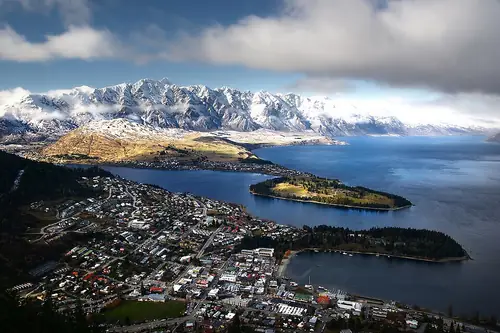
Once you’ve arrived, Queenstown flips the equation: you mostly don’t need a car for the town itself. Central Queenstown is compact and walkable: the lakefront to the Skyline Gondola base station is a 5-10 minute walk, and most cafés, the Mall shops and Fergburger-style eateries sit within that same easy radius. Orbus local buses run the CBD-Frankton-Arthurs Point-airport corridor with a flat fare around NZD 2.50 (~$1.45) on a Bee Card, the same tap-on smartcard used for the airport route. Where a car earns its keep is day trips outside town (Milford Sound, Glenorchy, or a run out to Arrowtown), and even for those, a self-drive day tour or a coach transfer covers it without needing a rental for your whole stay.
Frequently Asked Questions
Do you drive on the left or right in New Zealand?
New Zealand drives on the LEFT, the same side as the UK, Australia and Japan. Give way at the country’s many one-lane bridges per the signage (usually whoever hits the give-way sign first yields), and remember the give-way-to-the-right rule at unmarked intersections. Most rental cars and campervans are automatic, but confirm this when booking if you’re not used to a manual gearbox on the left.
What is a green warrant self-containment certificate for a New Zealand campervan?
Since 7 June 2026, freedom camping (parking overnight outside a paid campsite) requires a vehicle carrying a current green warrant self-containment certificate, which replaced the old blue warrant. It confirms the vehicle can store its own waste water and sewage for at least 3 days. Check a rental campervan’s certification before booking if you’re planning to freedom camp, since not every vehicle in a rental fleet qualifies.
Should I fly, drive or take the train between New Zealand cities?
Self-drive (car or campervan) covers most itineraries and gives the most flexibility for stops along the way. Domestic flights on Air New Zealand or Jetstar are faster for long hops like Auckland-Queenstown. InterCity coaches are the budget option linking most towns. New Zealand’s scheduled passenger rail is essentially scenic-only (the TranzAlpine, Coastal Pacific and Northern Explorer), not a practical way to commute between cities on a schedule.
Is there a train between Christchurch and Queenstown?
No scheduled passenger train runs directly to Queenstown. The closest scenic option is the TranzAlpine, which crosses the Southern Alps between Christchurch and Greymouth on the West Coast, run by Great Journeys NZ (KiwiRail). To reach Queenstown from Christchurch, drive (around 5 hours), fly, or take an InterCity coach.
How do I get around Queenstown itself without a car?
Central Queenstown is small and walkable: the lakefront to the Skyline Gondola base is a 5-10 minute walk. Orbus local buses (Bee Card, flat fare around NZD 2.50/~$1.45) connect the CBD, Frankton, Arthurs Point and the airport. A car is really only needed for day trips like Milford Sound, Glenorchy or Arrowtown.
Plan Your New Zealand Transport Now
Pick self-drive if the trip is about the road itself: the fjords, the alpine passes, the freedom to stop. Pick a domestic flight the moment a drive would eat a full day you’d rather spend somewhere scenic. Let InterCity fill in the budget gaps, and treat the TranzAlpine or Northern Explorer as a trip highlight, not a transfer. Inside Queenstown, walk or ride Orbus and save the rental for the day trips that actually need one.
Find flights to Queenstown | Compare Queenstown hotels
Keep planning with the New Zealand travel guide pillar, the New Zealand budget breakdown, the Queenstown, Milford Sound, Rotorua and Abel Tasman guides, a travel eSIM for checking live timetables and maps on the road, and hotels for wherever the drive ends each night.