Quick Answer
- Entry: 5 JD for foreign visitors at the Visitor Centre, or free with the Jordan Pass (70 to 80 JD).
- Best time: March to May and September to November; winter nights fall close to freezing.
- Where to stay: a desert camp, around 47 to 225 US dollars a night for two in November 2026.
- Getting there: about 55 minutes from Aqaba, 1.5 hours from Petra, 3.5 hours from Amman.
- How long: one night with a half-day jeep tour; two for hiking or a full-day tour.
At a glance
- Best time
- March to May, September to November
- Time needed
- 1 to 2 nights
- Currency
- Jordanian dinar (JOD)
- Language
- Arabic; English widely spoken
- Getting around
- Taxi, tour transfer or hire car
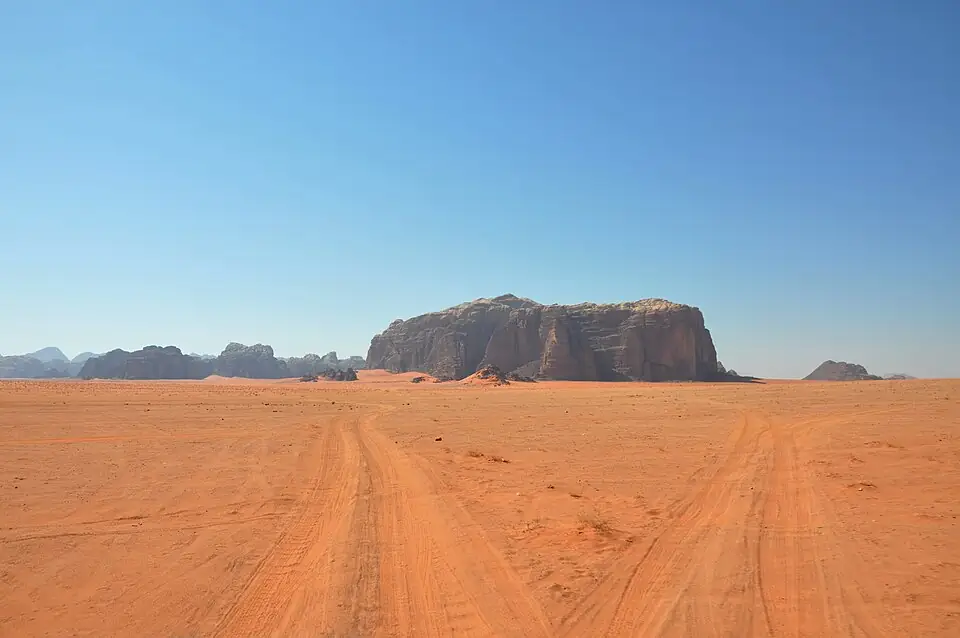
Wadi Rum is a protected desert of sandstone and granite mountains, red sand valleys and rock arches in the far south of Jordan, home to Bedouin communities of the Zawaideh and Zalabieh tribes. UNESCO inscribed it in 2011 as a mixed natural and cultural site, citing some 25,000 rock carvings and 20,000 inscriptions spanning 12,000 years of human presence. The trip comes down to four decisions: the season, which kind of camp, how long a jeep tour, and how you get there. Fees and prices below were checked on 10 October 2026.
When is the best time to visit Wadi Rum?
Spring and autumn. The Aqaba Special Economic Zone Authority (ASEZA), which manages tourism in the Aqaba region, names them the ideal seasons and gives summer highs of around 34°C and winter lows between 0 and 16°C in the desert. There is no published official climate normal for Wadi Rum itself, so the table uses the nearest WMO station, Aqaba on the Red Sea coast. The desert sits well above the coast, so expect nights in Wadi Rum to be noticeably colder than these Aqaba figures.
| Month | Aqaba average high / low (WMO) | Rain days | What it means in Wadi Rum |
|---|---|---|---|
| November | 27°C / 15°C | about 1 | Warm days, cool nights: a sweet spot |
| December | 22°C / 10°C | about 2 | Pleasant days, cold nights near freezing |
| January | 21°C / 9°C | about 2 | The coldest month: heated tent or warm layers |
| February | 22°C / 10°C | about 1 | Crisp clear skies, cold evenings |
| March to May | 26–35°C / 13–21°C | 0 to 2 | Wildflowers in spring, the busiest season |
| June to August | 38–39°C / 24–25°C | none | Jeep tours at dawn and late afternoon only |
| September and October | 33–36°C / 20–23°C | under 1 | Hot days easing into autumn |
Winter is the quiet season, not the closed one. Days are often sunny and ideal for hiking and jeep tours. The cost is the night: clear desert skies lose their heat quickly, and that same clarity is what makes winter stargazing so good.
How much does it cost to enter Wadi Rum?
The Jordan Tourism Board’s published fee list gives 5 JD for foreign visitors and 1 JD for Jordanians to enter Wadi Rum. You pay at the Wadi Rum Visitor Centre at the entrance to the Protected Area, which ASEZA calls the first stop for every visitor; guides and jeep tours can also be arranged there.
The Jordan Pass covers it. Run by the Ministry of Tourism and Antiquities, the pass lists Wadi Rum among its included attractions and costs 70, 75 or 80 JD depending on whether you want one, two or three consecutive days at Petra. It also waives the tourist visa fee if you buy it before arrival and stay at least two nights in Jordan. Pass holders still stop at the Visitor Centre to show it.
Where should you stay in Wadi Rum?
Almost everyone sleeps in a desert camp, and the choice is about comfort, not location: most camps sit inside or on the edge of the Protected Area, a jeep ride from the Visitor Centre.
| Camp type | Best for | Trade-off |
|---|---|---|
| Simple Bedouin camp | Budget travellers, the traditional experience | Shared bathrooms, thin walls, cold at night in winter |
| Mid-range camp with private tents | Most first-timers: private bathroom, dinner included | Can feel busy when tour groups arrive |
| Luxury dome or “bubble” camp | Stargazing from bed, heating, couples | The highest prices; some sit close together |
| Camps near Disi or Rum village | Easy road access, simpler transfers | Less remote than deep-desert camps |
On Booking.com, a Saturday night for two in mid-November 2026 ranged from around 47 US dollars at a simple camp to around 225 dollars at a luxury camp, with most well-rated camps around 55 to 100 dollars. Check what is included: many camps bundle dinner, breakfast, pick-up from the Visitor Centre and a jeep tour. Compare Wadi Rum desert camps
How do you get to Wadi Rum?
Wadi Rum has no airport of its own. Aqaba’s King Hussein International Airport (AQJ) is the nearest gateway; most international visitors fly into Queen Alia International Airport near Amman instead.
Mobile data helps when you arrange a camp pick-up; coverage in the deep desert is patchy, so save your camp’s phone number and download offline maps first.
- Activate before you fly: data works on arrival
- Plans for 200+ countries from a few dollars
- Keep your number; no physical SIM swap
What should you not miss in Wadi Rum?
| Experience | How long | Tip |
|---|---|---|
| Jeep tour | 2 hours to a full day | Book with your camp or at the Visitor Centre; half a day covers the classic sights |
| Sunset from a dune or rock | About an hour | Most camps build it into the afternoon tour |
| Stargazing | An evening | Clear winter skies are the best; organised telescope sessions run nearby |
| Rock bridges (Um Fruth, Burdah) | Short scramble to a half-day hike | Burdah is a serious climb: go with a local guide |
| Lawrence’s Spring and the Nabataean temple | A short walk from Rum village | Steps cut into the hillside lead up to the spring |
| Camel ride | An hour or more | Slower and quieter than a jeep |
| Hot air balloon | About an hour in the air | ASEZA lists early-morning flights at 6:00 |
Jeep tours are the standard way to see the Protected Area, and the Jordan Tourism Board’s advice is to book one through your camp or the Visitor Centre. A typical half-day route takes in red dunes, narrow canyons, rock inscriptions and at least one natural arch, ending with sunset.
Stargazing is the reason to stay the night. The Jordan Tourism Board lists telescope experiences in the area run with professional astronomers, but a camp away from the lights already gives you the Milky Way on a moonless night.
Hiking. ASEZA lists Jabal Umm ad Dami, Jordan’s highest mountain at around 1,850 metres, as a roughly two-hour ascent with little scrambling, and the Jordan Trail’s Petra to Wadi Rum section crosses 125 kilometres in six hiking days. Go with a licensed Bedouin guide for anything beyond the main valleys.
Food. Camp dinners usually centre on zarb, meat and vegetables slow-cooked in a pit under the sand, with Bedouin tea and coffee around the fire. The Jordan Tourism Board also lists cooking experiences with local women and a pottery workshop at the Disi Women’s Cooperative.
What goes wrong in Wadi Rum?
- Underestimating the cold. Packing only for desert heat in December or January leaves you shivering after sunset. Bring a fleece, a hat and warm socks, and ask whether your tent is heated.
- Arriving without a pick-up plan. Camps are spread across the desert and mobile signal fades. Confirm the meeting point and time, usually the Visitor Centre or Rum village, before you set off.
- Driving an ordinary car into the sand. Hire cars get stuck; leave yours where the camp tells you.
- Summer middays. From June to August the desert passes 34°C; schedule tours for early morning and late afternoon and carry plenty of water.
- Comparing camps on price alone. A cheap camp that charges extra for dinner, pick-up and the jeep tour can end up costing more than a pricier all-in package.
How many days do you need in Wadi Rum?
One night is right for most itineraries: arrive by early afternoon, take a half-day jeep tour that ends at sunset, eat at camp, stargaze, and leave after sunrise the next morning. Add a second night for a full-day jeep tour, a guided climb to a rock bridge or a hike up Jabal Umm ad Dami. Most travellers pair Wadi Rum with Petra, 1.5 hours away, and finish on the Red Sea at Aqaba. Our best time to visit Jordan guide covers the whole country month by month.
Frequently Asked Questions
How much is the Wadi Rum entrance fee?
The Jordan Tourism Board lists the Wadi Rum Protected Area fee at 5 Jordanian dinars for foreign visitors and 1 dinar for Jordanians, paid at the Visitor Centre at the entrance. Wadi Rum is one of the sites included in the Jordan Pass, so pass holders show it at the Visitor Centre instead of paying.
What is the best time to visit Wadi Rum?
March to May and September to November are the most comfortable months, with warm days and mild nights. Summer highs reach around 34°C in the desert, and in winter the Aqaba Special Economic Zone Authority puts lows between 0 and 16°C, so a December or January night in a camp can drop close to freezing.
How do I get to Wadi Rum?
Wadi Rum lies 66 kilometres north of Aqaba. The Aqaba Special Economic Zone Authority puts the drive at about 55 minutes from Aqaba, 1.5 hours from Petra and 3.5 hours from Amman. Taxis from Aqaba or Petra, hotel-arranged transfers, tours and hire cars all work, and JETT lists Wadi Rum among its coach destinations.
Should I stay overnight in Wadi Rum?
Yes, if you can. A day trip covers a jeep tour, but the reason most visitors come is the night: sunset over the sandstone, a Bedouin dinner and a dark sky full of stars. Camps range from simple Bedouin tents to heated luxury domes, and one night is enough for most itineraries.
How much does a Wadi Rum camp cost?
On Booking.com in October 2026, a night for two in mid-November ranged from around 47 US dollars at simple camps to around 225 dollars at luxury camps, with most well-rated camps around 55 to 100 dollars. Many camps bundle dinner, breakfast and a jeep tour, so compare what is included rather than the headline price.
How cold does Wadi Rum get at night?
Cold enough to plan for. Winter lows in the desert range from 0 to 16°C according to the Aqaba Special Economic Zone Authority, and clear desert skies lose heat fast after sunset. Between December and February pack a warm layer, a hat and socks for the evening, and ask your camp whether tents are heated.
Start planning your Wadi Rum trip
If Wadi Rum is a stop on an organised Jordan tour, the camp is usually chosen for you and only the season matters. If you are travelling independently, buy the Jordan Pass before you fly, book one night in a camp that includes pick-up and a jeep tour, and slot it between Petra and Aqaba.
Find cheap flights to Aqaba | Compare Wadi Rum camp prices
Planning the wider trip? See our Petra travel guide, the best time to visit Jordan guide and the hotels hub.