Quick Answer
- Best time: March to May and late September to November.
- Where to stay: Santa Cruz for the old quarter, Centro for buzz, Triana for local value.
- From the airport: EA bus, 6 euros; taxi fixed at 26 euros (29 euros nights and weekends).
- Book ahead: Real Alcázar 15.50 euros, Cathedral and Giralda 13 euros online.
- Getting around: the centre is compact, flat and walkable.
At a glance
- Best time
- Mar-May, late Sep-Nov
- Currency
- Euro (€)
- Language
- Spanish
- From the airport
- EA bus €6; taxi €26-29
- Visa
- Schengen rules; EES at the border
- Getting around
- Walkable centre; one tram line
Quick tips
- Avoid July and August. Average highs are around 36°C, and heatwaves go past 40°C.
- Book the Alcázar and the Cathedral online. Both run on timed slots with limited capacity.
- Take the EA bus or a fixed-fare taxi in. No need to overthink the airport.
- Stay in Santa Cruz, Centro or Triana and walk everywhere.
- Plan around Holy Week and the Feria de Abril. Magical, but the most expensive weeks of the year.
Prices below were checked against the official operators listed at the bottom of the page.
How do you get from the airport to central Seville?
| Option | 2026 price | Good to know |
|---|---|---|
| EA airport bus | 6 euros single, 8 euros return | Runs daily from early morning to around midnight; stops at Santa Justa station, Prado de San Sebastián, Torre del Oro and Plaza de Armas; pay by card on board |
| Taxi | 26 euros fixed (weekdays 7 am to 9 pm), 29 euros (nights, weekends, holidays, Holy Week) | Fixed fare to the city centre; small charge for bags over 10 kg |
For two or more people arriving late, the taxi is barely more than two bus tickets. Solo with a backpack, take the bus.
What to pack for Seville
Four picks from our gear guides that suit this trip. Each card opens the live Amazon price; the links below lead to the full comparisons.
25 x 18 x 4 cm, 254 g, 2.1 L. Locking zips, a cut-resistant double-cable strap, an RFID passport pocket and a strap that clips to a chair. Reader’s Digest’s best crossbody for travel.
Check price on Amazon Live price on AmazonThe best value compression set going. A double-zip pulls the air out so a week of clothes shrinks to a few inches thick, and you get eight pieces (cubes plus a shoe and laundry bag) for roughly the price of one branded cube. The fabric is thin and the zips aren’t lifetime kit, but for the money nothing beats it.
Check price on Amazon Live price on AmazonThe reliable all-rounder: one USB-C and four USB-A ports, plugs for 200+ countries, and a built-in fuse with a spare. The adapter most people should buy.
Check price on Amazon Live price on AmazonModel A1259, 10,000mAh, about 37Wh, 215 g. Two phone charges in a jacket pocket, and small enough that the two-bank limit never becomes a question.
Check price on Amazon Live price on AmazonHow do you get around Seville?
When is the best time to visit Seville?
Spring and autumn win; summer punishes. Average highs below come from AEMET’s climate normals for Seville Airport.
| Season | Average daily high | Crowds | Prices | Best for |
|---|---|---|---|---|
| Spring (Mar to May) | 22 to 27°C | Peak at Holy Week and the Feria | Highest around Easter and the Feria | Orange blossom, festivals, terraces |
| Summer (Jun to Aug) | 32 to 36°C, heatwaves above 40°C | Lighter | Lower | Early-morning sights and long siestas |
| Autumn (Sep to Nov) | 20 to 32°C, cooling through the season | Easing | Good value | The best balance of warmth and calm |
| Winter (Dec to Feb) | 16 to 18°C | Low | Cheapest of the year | Quiet sights, bargain stays |
Holy Week (Semana Santa) runs from Palm Sunday to Easter Sunday (21 to 28 March in 2027), and the Feria de Abril follows about two weeks after Easter. Both fill the city and push hotel prices to their yearly peak, so book months ahead or avoid those weeks entirely.
Where should you stay in Seville?
Most sights sit on the east bank of the Guadalquivir, with Triana across the water.
| Neighbourhood | Vibe | Price level | Best for |
|---|---|---|---|
| Santa Cruz | Old Jewish quarter, tiled lanes | High | First-timers, walking to the Alcázar |
| Alfalfa / Centro | Lively, tapas counters | Mid | Buzz, value, central |
| Triana | Local, riverside, ceramics and flamenco | Mid to lower | Atmosphere, markets |
| Arenal | Riverside, calm | Mid to high | A quieter base near the Cathedral |
For a first visit, pick Santa Cruz and lose yourself in the lanes. Triana, across the Isabel II bridge, feels like a neighbourhood rather than a postcard and its market is excellent. Our Seville where-to-stay guide goes area by area.
What should you not miss in Seville?
| Sight | Ticket | Tip |
|---|---|---|
| Real Alcázar | 15.50 euros; free Monday slot (4 to 5 pm Oct to Mar, 6 to 7 pm Apr to Sep), booked online | Go at opening, before the heat and the groups |
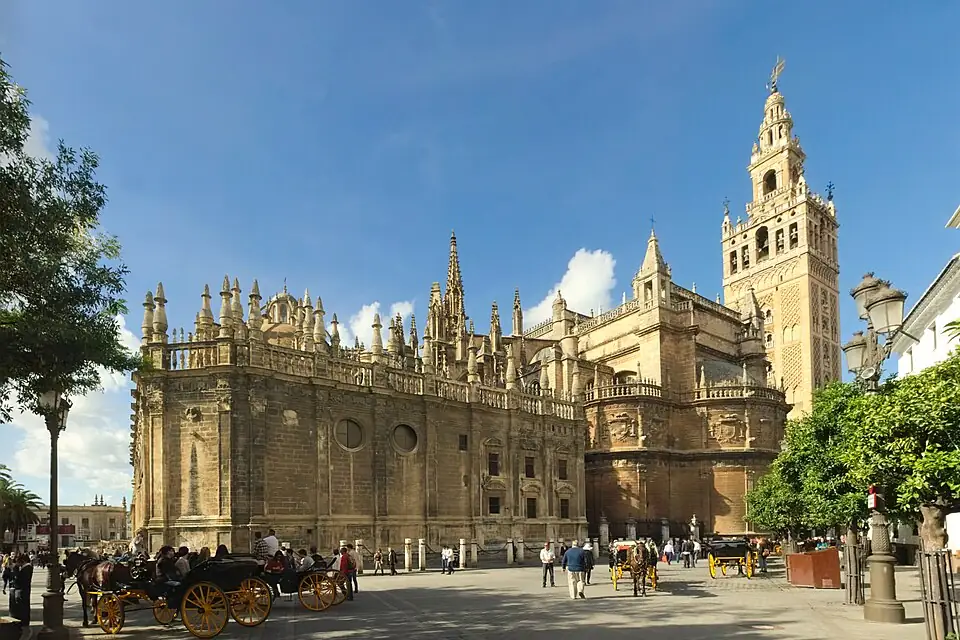
| Cathedral and Giralda | 13 euros online, 14 euros at the ticket office (includes the Church of El Salvador) | The Giralda climb is 34 ramps and 17 steps; allow about 75 minutes in total |
| Plaza de España | Free | Early or late for soft light and space |
| Santa Cruz lanes | Free | Get a little lost; the patios hide off the side streets |
| Triana | Free | Tile workshops, the market and the riverside |
| Metropol Parasol (Las Setas) | Paid rooftop walkway | Best as the day cools |
The quiet wins are free: orange blossom in spring, the Guadalquivir at dusk, a Santa Cruz courtyard once the day-trippers have gone.
How do you eat well in Seville without overpaying?
- Breakfast like a sevillano: a tostada with olive oil and tomato and a coffee at a stand-up counter.
- Lunch at the Mercado de Triana: fresh produce and cooked plates, far better value than the squares ringed with photo menus.
- Order montaditos at a busy counter, a few at a time, where everyone is standing.
- Go for the menú del día: the best-value sit-down meal in the city.
Frequently Asked Questions
What is the best time to visit Seville?
March to May and late September to November are the sweet spot: average highs of roughly 22 to 27°C in spring, orange blossom in the air and prices below the Easter and Feria peaks. July and August average around 36°C and heatwaves pass 40°C, so locals slow right down. Winter is mild (highs around 16°C), quiet and the cheapest the city gets.
Where should I stay in Seville for the first time?
Santa Cruz, the old Jewish quarter, drops you in a maze of lanes right beside the Cathedral and Real Alcázar. Alfalfa and Centro are lively and central with easy walking, while Triana across the river is more local and a touch cheaper. Pick one base and walk.
How do I get from Seville airport into the centre?
The EA airport bus runs into the city every day from early morning to around midnight, stopping at Santa Justa station, Prado de San Sebastián, Torre del Oro and Plaza de Armas. A single costs 6 euros and a return 8 euros, payable by card on board. Taxis charge a fixed 26 euros to the centre on weekday daytimes and 29 euros at night, at weekends and on holidays.
Is Seville walkable?
Very. The historic core is compact and flat, so most sights are an easy stroll apart. There’s one tram line through the centre, the Sevici bike-share for short hops, and a single metro line that mostly serves the outskirts. You’ll rarely need anything but your feet.
Do I need to book Seville’s main sights in advance?
Yes. The Real Alcázar (15.50 euros) and the Cathedral with the Giralda (13 euros online, 14 at the ticket office) both use timed entry and limited capacity, so book on the official websites. The Alcázar also has a free Monday slot (4 to 5 pm from October to March, 6 to 7 pm from April to September), which must be reserved and goes fast.
What should I eat in Seville?
Head to Triana’s covered market for fresh local produce, then order montaditos (small filled rolls) at a busy counter where the locals stand. A menú del día (set lunch) is the best-value sit-down meal. Eat where the queue is local, not where the menu has photos.
Start planning your Seville trip
If your dates touch Holy Week or the Feria, don’t wait: those are the weeks Seville sells out. Any other time, check a few dates side by side before you book; the difference between a spring weekday and a festival weekend is large.
Find cheap flights to Seville | Compare Seville hotel prices
Planning the wider trip? See our best time to visit Spain guide and browse more stays on the hotels hub.