Quick Answer
- When: April to June and September to October; November to February for quiet cities at about 11 to 15°C.
- Base: Florence for trains; Siena for the Val d’Orcia; Lucca for a calmer stay near Pisa.
- Trains: Florence to Pisa 9.80 euros, to Siena 10.80 euros, to Lucca 8.90 euros, all flat fares.
- Pisa airport: PisaMover to Pisa Centrale in about 5 minutes for 6.50 euros.
- Tickets: Leaning Tower on opapisa.it only; Siena OPA SI pass 14 euros (16 euros while the floor is uncovered).
At a glance
- Best time
- Apr–Jun, Sep–Oct
- Time needed
- 5 to 7 days
- Currency
- Euro (EUR)
- Language
- Italian
- From the airport
- PisaMover to Pisa Centrale, about 5 minutes
- Getting around
- Trenitalia regional trains; car for hill towns
Tuscany is not one destination but four cities and a stretch of countryside, and the trip works best when you treat it that way. Florence, Pisa, Siena and Lucca are all linked by cheap regional trains; San Gimignano and the Val d’Orcia need a bus change or a car. Your plan comes down to the season, one base or two, and how much countryside you want. Fares, prices and opening hours below were checked on 10 October 2026.
When is the best time to visit Tuscany?
Spring and autumn give you warm days without the summer crowds. Winter is the off-season: the cities stay open and the queues shrink, but the days are short and wetter.
| Month | Average high / low in Florence | Rain days | What to expect |
|---|---|---|---|
| January | 10.9°C / 2.0°C | 8.3 | Quietest month, crisp and short days |
| February | 12.5°C / 2.5°C | 7.1 | Cold mornings, empty museums |
| March | 15.7°C / 4.9°C | 7.5 | Spring starts, still calm |
| April | 18.5°C / 7.5°C | 9.7 | Green hills, Easter crowds |
| May | 23.7°C / 11.6°C | 8.4 | The best all-round month |
| June | 27.7°C / 15.0°C | 6.3 | Long, warm days |
| July | 31.4°C / 17.7°C | 3.5 | Hot, busiest, little shade at Pisa |
| August | 31.5°C / 17.7°C | 5.4 | Hot and crowded; book early |
| September | 26.7°C / 14.4°C | 6.2 | Warm, crowds thinning |
| October | 20.9°C / 10.1°C | 8.5 | Autumn colour, wetter |
| November | 14.7°C / 5.1°C | 9.0 | Wettest month, new-season olive oil |
| December | 11.1°C / 2.6°C | 8.3 | Christmas lights, few tour groups |
Figures are the 1971-2000 Aeronautica Militare normals for Florence published by the World Meteorological Organization. Siena sits higher on its hills and the Val d’Orcia is more exposed, so expect them to feel a little colder in winter.
Is Tuscany worth it in winter?
Yes, for a city trip. The Leaning Tower of Pisa opens 9:00 to 18:00 from November, with last entry 30 minutes before closing, and Siena’s cathedral complex opens 10:30 to 17:30 from 1 November to 24 December 2026. Siena’s famous inlaid marble floor is uncovered until 15 November 2026, then covered again. The catch is the countryside: from November to February, the Val d’Orcia and San Gimignano are quieter but greyer, buses run less often and daylight ends around 17:00. For more winter ideas, see where to go in December and Christmas markets in Europe 2026.
Where should you stay in Tuscany?
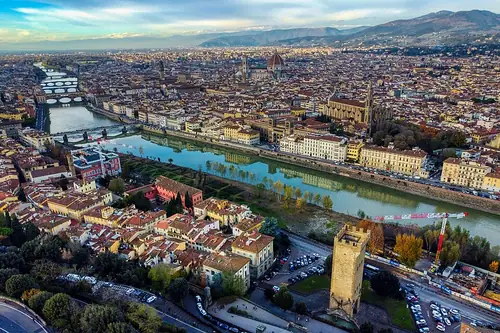
Pick a city base for trains, or a countryside base for views. Most first-timers do best with Florence plus one night in Siena.
| Base | Best for | Trade-off |
|---|---|---|
| Florence | First-timers, art, the most train connections | Busiest and priciest; crowded in spring |
| Siena | Medieval streets, the Val d’Orcia, a calmer evening | Fewer direct trains; hilly streets |
| Lucca | Relaxed walled town, easy for Pisa (about 30 minutes) | Quieter in the evening |
| Pisa | Late flights into Pisa airport, budget stays | Little to do beyond the Square of Miracles |
| San Gimignano | Evening calm once the day trippers leave | Bus change at Poggibonsi; limited choice |
| Val d’Orcia farmhouse stays | Landscapes, slow travel | A car is essential |
First time? Base in Florence and take day trips by train: our Florence where-to-stay guide breaks down the neighbourhoods. Add two nights in Siena if the Val d’Orcia is on your list. Rooms near Santa Maria Novella station save time on early trains, so compare Florence hotel prices for your dates before choosing.
How do you get to and around Tuscany?
Two airports serve the region: Florence (FLR) for the city and Pisa (PSA), often cheaper on budget airlines. Our Florence airport guide covers both routes in detail. From Rome, high-speed trains reach Florence in about 1 hour 32 minutes; see the Italy trains guide.
| Regional train (Trenitalia) | Typical time | Fare checked 10 October 2026 |
|---|---|---|
| Florence SMN to Pisa Centrale | about 1 hour to 1 hour 20 minutes | 9.80 euros |
| Florence SMN to Siena | about 1 hour 30 minutes | 10.80 euros |
| Florence SMN to Lucca | about 1 hour 20 minutes | 8.90 euros |
| Florence SMN to Poggibonsi-San Gimignano | about 1 hour 5 minutes | 8.90 euros |
| Pisa Centrale to Lucca | about 30 minutes | 4.10 euros |
| Siena to Buonconvento (Val d’Orcia edge) | about 35 minutes | 4.10 euros |
What should you not miss in Tuscany?
| Sight | Entry (2026) | Tip |
|---|---|---|
| Florence’s historic centre | Varies by museum | Two to three days; see our Florence guide |
| Leaning Tower of Pisa | Timed ticket on opapisa.it, around 20 euros, includes free Cathedral entry | 251 steps, about 30 minutes; no under-8s |
| Siena cathedral complex (OPA SI pass) | 14 euros, 16 while the floor is uncovered | Valid three days; about two hours |
| Lucca’s walls | Free | 4.2 km round the old town, walk or cycle |
| San Gimignano | Free to walk | 14 of its tower-houses survive |
| Val d’Orcia | Free | UNESCO-listed farmland and hill towns |
- Pisa: UNESCO listed the Piazza del Duomo in 1987. Book the tower slot on the official site, arrive 15 minutes early to use the free cloakroom (bags are not allowed up), and walk across the river to the quieter old town afterwards.
- Siena: the Historic Centre is UNESCO-listed since 1995. The OPA SI pass covers the Cathedral, Piccolomini Library, Baptistery, Crypt, the Museo dell’Opera and the panorama from the unfinished façade; the separate Gate of Heaven pass, which adds the cathedral roof, costs 21 euros.
- Lucca: the walls have 11 bastions and became a public park in the late 1800s, so the whole loop is a flat, shaded walk.
- San Gimignano: its patrician families built around 72 tower-houses, some as high as 50 m, according to UNESCO, which listed the town in 1990.
- Val d’Orcia: listed by UNESCO in 2004 as a Renaissance agricultural landscape of chalk plains, conical hills and fortified villages, crossed by the old Via Francigena pilgrim route.
Eat from the markets. Tuscany’s food is about ingredients: pecorino sheep’s cheese, new-season olive oil in late autumn, bread, beans and cured meats from the food halls and weekly markets, and gelato in every town. A market picnic in the Val d’Orcia beats any roadside stop.
What day trips can you take from Florence?
- Pisa and Lucca in one day: train to Pisa (about 1 hour), the tower in the morning, then 30 minutes on to Lucca for the walls before the train back to Florence.
- Siena: about 1 hour 30 minutes by regional train; give it a full day.
- San Gimignano: train to Poggibonsi-San Gimignano (about 1 hour 5 minutes), then a local bus up the hill. Easier by car if you also want the Val d’Orcia.
- Val d’Orcia: best by car over two days from Siena. Buonconvento is on the rail line, but the hill towns beyond it are not.
- Further afield: Rome and Venice are both high-speed train rides from Florence; our Italy itinerary links them.
What goes wrong in Tuscany?
- Driving into a ZTL. Cameras photograph number plates at the gates, and the fine arrives weeks later via your rental company.
- Missing your Pisa slot. Latecomers are not let in or refunded, and children under 8 cannot climb.
- Buying tower tickets from resellers. Use the official opapisa.it site; third-party sites add a markup.
- Trying the Val d’Orcia by bus in winter. Services are thin; rent a car or join a tour.
- Forgetting to validate a paper regional ticket. Stamp it on the platform before boarding.
Italy is in the Schengen area, so check the Schengen 90/180 rule and the EU Entry/Exit System and ETIAS guide before you fly. For data, see our Italy eSIM guide; for daily costs, our Italy budget guide.
How many days do you need in Tuscany?
Five to seven days: two or three in Florence, one for Pisa and Lucca, one for Siena, and one or two for San Gimignano and the Val d’Orcia. With only three days, stay in Florence and take one train day trip. In winter, plan for cities by day and early evenings, since it is dark by about 17:00.
Sources
Climate figures come from the WMO’s publication of Aeronautica Militare normals for Florence. Ticket rules, prices and hours were checked on 10 October 2026 against the Opera della Primaziale Pisana, the Opera della Metropolitana di Siena, Pisamover, Trenitalia’s fare search, Visit Tuscany and UNESCO. The full list sits in the sources box below.
Frequently Asked Questions
When is the best time to visit Tuscany?
April to June and September to October are the sweet spot: Florence averages highs of about 18 to 28°C, according to Aeronautica Militare normals published by the WMO, and the countryside is green or harvest-gold. July and August average highs around 31°C with the heaviest crowds. November to February is quiet and cheaper, with highs of about 11 to 15°C and short days.
Is Tuscany worth visiting in winter?
Yes, if you want the cities rather than the countryside. Florence, Pisa, Siena and Lucca stay open all winter with far shorter queues, and the Leaning Tower opens 9:00 to 18:00 in November. The trade-offs are short daylight, about eight to nine rainy days a month in Florence from October to January, and fewer buses to the small hill towns.
Where should I stay in Tuscany for the first time?
Florence is the easiest first base: it has the most trains, and Pisa, Siena and Lucca are all day trips from Santa Maria Novella station. Siena suits travellers who want a calmer medieval city closer to the Val d’Orcia. Lucca is the relaxed choice for Pisa and the coast. Stay in the Val d’Orcia itself only if you have a car.
How do I get from Florence to Pisa, Siena and Lucca by train?
Trenitalia regional trains run from Firenze Santa Maria Novella to Pisa Centrale in about 1 hour for 9.80 euros, to Siena in about 1 hour 30 minutes for 10.80 euros and to Lucca in about 1 hour 20 minutes for 8.90 euros. Fares are flat, so there is no need to book ahead, but validate a paper ticket before boarding.
How do I book the Leaning Tower of Pisa?
Buy a timed ticket on the official opapisa.it site: it costs around 20 euros and also gives free entry to Pisa Cathedral. The climb takes about 30 minutes over 251 steps, children who have not turned 8 by the end of the year cannot go up, and bags must be left at the free cloakroom. If you arrive late for your slot, you are not let in or refunded.
How many days do you need in Tuscany?
Five to seven days covers the classics without rushing: two or three days in Florence, a day each for Pisa with Lucca and for Siena, and one or two days in San Gimignano and the Val d’Orcia. Three days is enough for Florence plus one day trip, but not for the countryside.
Start planning your Tuscany trip
Compare flights into both Florence and Pisa: the cheaper airport often changes by date, and the two are linked by a train of about an hour.
Find cheap flights to Florence | Compare Tuscany hotel prices
Planning the wider trip? See our best time to visit Italy guide, Naples and Sicily for the south, and the hotels hub.