Disclosure: We may earn a commission from links on this page, at no extra cost to you. How we earn
This article contains affiliate links. If you make a booking through these links, we may earn a commission at no extra cost to you. About & Affiliate Disclosure
Quick Answer
At a glance
- Best time
- Apr–Jun, Sep; Nov–Dec for markets
- Time needed
- 5 to 7 days
- Currency
- Hungarian forint (HUF)
- Language
- Hungarian
- From the airport
- Budapest Ferenc Liszt: Bus 200E to Kőbánya-Kispest + Metro M3, ~50 min
- Getting around
- MÁV trains; e-vignette for motorways
Hungary is a small country with one very large capital. Most trips are a Budapest city break with a side trip or two, so the questions are when to go, which season suits your plan, and what it all costs. All prices and dates below were checked on 4 October 2026.
Hungary month by month
The climate is continental: hot summers, cold winters and comfortable shoulder seasons. The figures are HungaroMet’s 1991-2020 normals for Budapest and for Siófok on the south shore of Lake Balaton.
| Month | Budapest high / low | Balaton (Siófok) high | Best for |
|---|---|---|---|
| January | 3.0°C / -2.5°C | 2.7°C | Thermal baths, lowest prices |
| February | 5.8°C / -1.3°C | 5.2°C | Baths, quiet city breaks |
| March | 11.3°C / 2.3°C | 10.5°C | Early spring sightseeing |
| April | 17.9°C / 7.1°C | 17.0°C | Walks, parks, Easter |
| May | 22.6°C / 11.6°C | 22.0°C | The best all-round month |
| June | 26.2°C / 15.2°C | 25.8°C | Long evenings, Balaton warming up |
| July | 28.1°C / 16.7°C | 27.8°C | Lake Balaton; hot and busy in Budapest |
| August | 28.0°C / 16.6°C | 27.5°C | Lake Balaton, festivals |
| September | 22.5°C / 12.2°C | 21.8°C | Warm days, thin crowds |
| October | 16.4°C / 7.2°C | 16.0°C | Autumn colours, cheaper hotels |
| November | 9.4°C / 3.1°C | 9.2°C | Christmas markets from 13 November |
| December | 3.5°C / -1.4°C | 3.7°C | Markets, lights and baths |
July is Budapest’s wettest month (75 mm on average) and January to March the driest. The winter months sit around freezing, so pack warm: see our guides to packable down jackets and winter boots for travel.
Top Cities to Explore
Best time to visit Hungary by trip type
Christmas markets (mid-November to December)
Budapest is the reason to come. Advent Basilica, on the square in front of St Stephen’s Basilica, runs from 13 November 2026 to 1 January 2027, open 11:00 to 22:00 from Sunday to Thursday and to 23:00 on Fridays and Saturdays. Vörösmarty Classic Xmas, the city’s oldest market, opens the same day; its closing date had not been published on 4 October 2026. The draw is the food and crafts: chimney cake, lángos, hot chocolate and Hungarian handicrafts. Our Budapest city guide has the hours, where to stay and the baths in one place, and the Christmas markets in Europe 2026 guide compares Budapest with the rest of the continent.
Budapest also closes the classic rail triangle with Vienna and Prague: Austrian, Czech and Hungarian markets run past Christmas, so a late-December trip still works here. Our Christmas markets by train guide has the routes.
Thermal baths and spas (October to March)
Hungary sits on hot springs, and the baths are best when the air is cold. In Budapest, Széchenyi Bath in City Park charges 13,200 Ft for a weekday adult ticket with locker in 2026, rising to 14,800 Ft on Fridays and weekends. Rudas Bath on the Buda riverbank charges 12,000 Ft on weekdays and runs night bathing on Fridays and Saturdays. Gellért Bath closed on 1 October 2025 and is planned to reopen in 2028.
Outside the capital, Lake Hévíz near the western end of Balaton is a spring-fed thermal lake roughly 250 metres across, where you can bathe outdoors year-round.
Summer and Lake Balaton (late June to August)
Central Europe’s largest lake is Hungary’s summer holiday. Average highs at Siófok reach about 28°C in July, and the shallow water warms quickly. The south shore has the beaches and family resorts; the north shore has the Tihany peninsula, hills and quieter villages. Budapest itself is hot and crowded in July and August, so split the trip between the city and the lake.
Spring and autumn (April to June, September to October)
These are the best months for Budapest walking, the Danube Bend towns of Szentendre, Visegrád and Esztergom, Eger’s castle and the Baroque city centre, and Pécs in the south. Prices sit between winter lows and summer highs.
Where to stay in Hungary
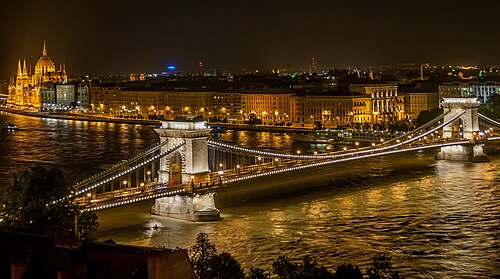
Base yourself in Budapest for most of the trip; our Budapest city guide compares the districts. Stay in District V or VI on the Pest side for a first visit: you can walk to the Parliament, the Danube and both Christmas markets. For named hotels and prices by district, see our best budget hotels in Budapest.
How much does Hungary cost per day?
Hungary is one of the cheaper countries in the EU, and Budapest outside District V is better value than Vienna or Prague’s centre. Daily totals are rough guides; the fixed costs come from official 2026 price lists.
| Item | Typical cost |
|---|---|
| Budget hotel or private room in Budapest | From around 30 to 65 euros a night |
| Single BKK ticket | 500 Ft (700 Ft if bought on the spot) |
| 72-hour Budapest travelcard | 5,750 Ft |
| Airport bus 100E | 2,500 Ft |
| Széchenyi Bath, adult day ticket with locker | 13,200 to 15,800 Ft |
| Parliament tour | 7,000 Ft for EEA citizens, 14,000 Ft for others |
| Daily total, budget traveller | Around 45 to 75 euros |
| Daily total, mid-range traveller | Around 100 to 160 euros |
For how Hungary compares with its neighbours, see the cheapest European countries to visit in 2026.
Getting around Hungary
By train. The national operator MÁV links Budapest with Lake Balaton, Eger, Pécs and the Danube Bend. For international trips, MÁV’s START Europa tickets to Austria start from 13 euros one-way in second class, and direct trains reach Vienna in around 2 hours 20 minutes to 2 hours 40 minutes.
By car. Motorways and expressways need an e-vignette (e-matrica), bought online and linked to your number plate. In 2026, a national vignette for a car in category D1 costs 5,550 Ft for one day, 6,900 Ft for 10 days and 11,170 Ft for a month. Driving in Budapest itself is slow and parking is scarce, so leave the car until you head out of the city.
In Budapest. Use the BKK metro, trams and buses; a 24-hour travelcard costs 2,750 Ft. The airport bus 100E needs its own 2,500 Ft ticket.
Entry requirements, money and connectivity
Entry. Hungary is in the Schengen area, so the 90-days-in-180 rule applies across all member states; see our Schengen 90/180 rule guide. Non-EU visitors are registered by the biometric Entry/Exit System at the border, and ETIAS has not started yet: our EES and ETIAS guide tracks both.
Money. Hungary uses the forint (HUF), not the euro. Cards are widely accepted in Budapest, including at the baths and on the airport bus. Whenever a card terminal or cash machine offers to charge you in your home currency, decline and choose forints: dynamic currency conversion rates are usually worse than your bank’s.
Mobile data. A Europe eSIM works across Hungary and its neighbours; compare options in our best eSIM for Europe guide.
- Activate before you fly: data works on arrival
- Plans for 200+ countries from a few dollars
- Keep your number; no physical SIM swap
Frequently Asked Questions
What is the best time to visit Hungary?
April to June and September are the best months for most trips, with average highs of about 18 to 26°C in Budapest according to HungaroMet and far fewer crowds than July and August. Mid-November to December is the best time for a winter city break, when the Budapest Christmas markets run and the outdoor thermal pools steam in the cold. July and August suit Lake Balaton.
When are the Christmas markets in Hungary in 2026?
Budapest’s two main markets both open on 13 November 2026. Advent Basilica on St Stephen’s Square runs until 1 January 2027, from 11:00 to 22:00 Sunday to Thursday and to 23:00 on Fridays and Saturdays. Vörösmarty Classic Xmas on Vörösmarty Square had not published its closing date on 4 October 2026.
How much does a trip to Hungary cost per day?
Hungary is one of the cheaper countries in the EU. In Budapest, a budget traveller can manage on around 45 to 75 euros a day and a mid-range traveller on around 100 to 160 euros, with budget hotels from around 30 euros a night. Fixed costs in 2026 include a 72-hour BKK travelcard at 5,750 Ft and a weekday Széchenyi Bath ticket at 13,200 Ft.
Do I need a vignette to drive in Hungary?
Yes, on motorways and expressways you need an e-vignette (e-matrica), bought online before you drive onto a toll road. For a car in category D1 in 2026, a national daily vignette costs 5,550 Ft, a 10-day vignette 6,900 Ft and a monthly vignette 11,170 Ft. There is no sticker: the vignette is linked to your number plate.
Can I pay in euros in Hungary?
Hungary uses the forint (HUF), not the euro. Cards are widely accepted in Budapest, including on the airport bus and at the main thermal baths. When a card machine or cash machine offers to charge you in your home currency, decline and pay in forints, because that dynamic currency conversion rate is usually worse than your bank’s.
Is Gellért Bath open in 2026?
No. Gellért Thermal Bath closed on 1 October 2025 for renovation, and its operator plans to reopen it in 2028. Széchenyi Bath in City Park and Rudas Bath on the Buda riverbank are both open, and Széchenyi charges 13,200 Ft for a weekday adult ticket with locker in 2026.
Start planning your Hungary trip
Book the Budapest room first if you are going for the Christmas markets: central hotels fill on December weekends before flights get expensive. For a spring or autumn trip, compare a few dates in May and September.
Find cheap flights to Budapest | Compare Budapest hotel prices
More ideas: where to go in November, where to go in December and cheap flights from Berlin to Budapest.