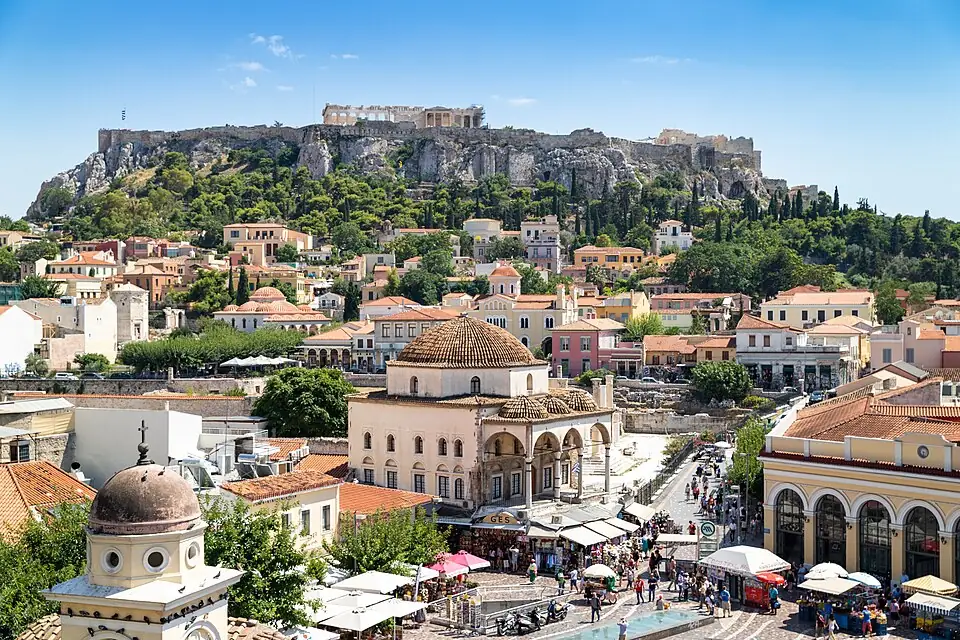
Quick Answer
- Best time: April to early June and September to October.
- Where to stay: Plaka or Monastiraki first time; Koukaki for a quieter base; Syntagma for transport.
- Airport: Metro line 3 to Syntagma, about 40 minutes, 9 euros; X95 bus 5.50 euros, 24 hours.
- Acropolis: 30 euros, timed slot booked online; the seven-site combo ticket ended in April 2025.
- Timing: climb at opening or late afternoon, museum at midday.
At a glance
- Best time
- Apr–early Jun, Sep–Oct
- Time needed
- 2 to 3 days
- Currency
- Euro (EUR)
- Language
- Greek
- From the airport
- Metro line 3, ~40 min, €9
- Getting around
- Metro, tram, bus; 90-min ticket €1.20
Two decisions shape an Athens trip more than any other: the month you come and the hour you climb the Acropolis. Get both right and the city is compact, walkable and easy. Get them wrong and you queue in full sun on hot marble. Fares and ticket rules below were checked against OASA and the Greek Ministry of Culture on 3 October 2026.
When is the best time to visit Athens?
The shoulder months win. High summer is the one to avoid if your dates are flexible.
| Season | Weather | Crowds and prices | Best for |
|---|---|---|---|
| Spring (Apr–Jun) | Warm, mostly dry, heating up through June | Building | Ruins, terraces, day trips |
| Summer (Jul–Aug) | Hot: average highs in the low to mid 30s °C, heatwaves above 40°C | Heaviest, peak prices | Long evenings; sightsee at dawn and after six |
| Autumn (Sep–Oct) | Warm, sea still swimmable | Easing | Calmer sites, softer prices, a coastal day |
| Winter (Nov–Mar) | Cool, wetter, often clear days | Low, cheapest | Museums and quiet ruins |
In summer, plan like a local: outdoor sites at opening, the air-conditioned Acropolis Museum at midday, and the evening for Plaka and Lycabettus. Heat can also close archaeological sites at midday on extreme days, so check before you go.
What to pack for Athens
Four picks from our gear guides that suit this trip. Each card opens the live Amazon price; the links below lead to the full comparisons.
25 x 18 x 4 cm, 254 g, 2.1 L. Locking zips, a cut-resistant double-cable strap, an RFID passport pocket and a strap that clips to a chair. Reader’s Digest’s best crossbody for travel.
Check price on Amazon Live price on AmazonThe best value compression set going. A double-zip pulls the air out so a week of clothes shrinks to a few inches thick, and you get eight pieces (cubes plus a shoe and laundry bag) for roughly the price of one branded cube. The fabric is thin and the zips aren’t lifetime kit, but for the money nothing beats it.
Check price on Amazon Live price on AmazonThe reliable all-rounder: one USB-C and four USB-A ports, plugs for 200+ countries, and a built-in fuse with a spare. The adapter most people should buy.
Check price on Amazon Live price on AmazonModel A1259, 10,000mAh, about 37Wh, 215 g. Two phone charges in a jacket pocket, and small enough that the two-bank limit never becomes a question.
Check price on Amazon Live price on AmazonWhere should you stay in Athens?
The historic core is compact, so almost every central base puts the Acropolis within a short walk. For street-level detail, see our guide to where to stay in Athens.
| Neighbourhood | Feel | Best for |
|---|---|---|
| Plaka | Old-town lanes, neoclassical, touristy-charming | First-timers, walking to everything |
| Monastiraki | Lively, market-edged, central | Buzz, rooftop views, metro links |
| Koukaki | Calmer, residential, local cafés | A quieter base near the Acropolis Museum |
| Syntagma | Grand, central, transport hub | The airport metro on your doorstep |
| Thissio | Leafy, relaxed, Acropolis views | Calmer evenings, sunset walks |
Price check: for two nights in mid-October 2026, a Booking.com search in Plaka returned hotels at roughly 110 to 300 euros a night, with 5-star rooms well above that. Koukaki and the streets around Syntagma often come in lower.
How do you get around Athens?
A clean metro plus a walkable centre covers almost everything, so you rarely need a taxi.
From Monastiraki up through Plaka to the Acropolis and across to the Ancient Agora is barely a couple of kilometres. Walk it.
What should you not miss in Athens?
- The Acropolis and the Parthenon. 30 euros for a standard adult ticket since April 2025, with a timed entry slot. There is no longer a combined ticket for the other ancient sites.
- The Acropolis Museum. At the foot of the hill, air-conditioned, with a glass top floor that frames the Parthenon. The ideal midday refuge.
- The Ancient Agora. The heart of classical Athens and the well-preserved Temple of Hephaestus, far quieter than the Acropolis. Separate ticket.
- Plaka and Anafiotika. Old-town lanes and the island-style hamlet on the Acropolis slope: free, and best in early evening.
- Lycabettus Hill at sunset. The city’s highest viewpoint, reached on foot or by funicular.
- A day trip. The Temple of Poseidon at Cape Sounion for sunset, or Delphi in the mountains for a full day.
Free open days: Greek archaeological sites admit everyone free on a handful of dates, including 6 March, 18 April, 18 May, 28 October and the first Sunday of each month from November to March. Expect crowds.
Eat cheaply where locals do:
- Souvlaki or gyros in pita, a few euros on the move.
- Central (Varvakios) Market for fish, meat and spice stalls, with simple cooked food at the edges.
- A bakery breakfast: tiropita (cheese pie) or spanakopita (spinach pie) fresh from the oven.
- Taverna daily specials in Koukaki, cheaper than the laminated menus by the big sights.
Frequently Asked Questions
What is the best time to visit Athens?
April to early June and September to October are the sweet spot: warm but bearable days, manageable crowds, and prices below the summer peak. July and August are hot, with average highs in the low to mid 30s °C and heatwaves above 40°C, which makes midday sightseeing miserable. Winter is cheaper and quiet, with cool, often clear days for ruins without the queues.
Where should I stay in Athens for the first time?
Plaka and Monastiraki put you in the walkable old town at the foot of the Acropolis, surrounded by sights and tavernas. Koukaki is quieter and a short stroll from the Acropolis Museum, while Syntagma is the transport hub with the airport metro on your doorstep. Any of them keeps you central and on foot.
How do I get from Athens airport into the city centre?
Metro line 3 (the blue line) runs from Athens International Airport to Syntagma and Monastiraki in about 40 minutes with no changes, on a 9 euro airport ticket. The X95 express bus runs 24 hours to Syntagma for 5.50 euros but is slower and depends on traffic. Staying three days? The 20 euro tourist ticket includes one airport round trip.
How much is the Acropolis ticket, and is there still a combo ticket?
A standard adult ticket to the Acropolis costs 30 euros, booked online for a timed entry slot. The old combined ticket for the Acropolis and six other ancient sites was discontinued in April 2025, so the Ancient Agora, the Roman Agora and the Temple of Olympian Zeus now each need their own ticket. Go at opening or in the late afternoon.
How many days do you need in Athens?
Two full days cover the headline sights: the Acropolis and its museum, Plaka, the Ancient Agora and a sunset on Lycabettus Hill. A third day lets you slow down or take a day trip to Cape Sounion or Delphi. Many travellers use Athens as a one or two-night gateway before the islands, which works well.
Is Athens walkable?
Very. The historic centre, from Plaka and Monastiraki up to the Acropolis and across to the Ancient Agora, is compact and largely pedestrianised, so you can see most of the headline sights on foot. The metro fills the gaps for the airport, the port at Piraeus and the further neighbourhoods.
Start planning your Athens trip
If your dates are fixed in August, you don’t need us to tell you it’ll be hot. Everyone else: check a few weeks either side of your plan, because shoulder-season fares and room rates move fast.
Find cheap flights to Athens | Compare Athens hotel prices
Heading on to the islands? See our Greek ferries guide, the best time to visit Greece and the hotels hub.