Quick Answer
- Best time to visit: late May to June and September, for warm days, long light and prices below the summer peak.
- Where to stay: Saint-Pierre (old town) for first-timers; Chartrons for calm and character; Triangle d’Or for upscale central; Gare Saint-Jean for budget and trains.
- Getting around: a very walkable centre plus four modern tram lines (A/B/C/D); one ticket covers tram and bus.
- Don’t miss: the miroir d’eau at Place de la Bourse, Saint-André cathedral, the Pont de Pierre, and a day trip to the Dune du Pilat and Arcachon.
- From Paris: TGV in about two hours, often cheaper and quicker than flying.
A Bordeaux Travel Guide for a City Often Skipped
Bordeaux is often filed under “a city you only visit for one thing,” which undersells it badly: even a packed single afternoon tends to stretch into two full days of walking the same honey-coloured quay at dusk, because the city is this good-looking without trying. So if Bordeaux isn’t on the list yet, it’s worth a second look. It might be the easiest French city break most travelers never plan.
Here’s the fast answer. Bordeaux is a UNESCO-listed 18th-century city built almost entirely from the same pale limestone, set on a long curve of the Garonne. The headline sights, the food and the day trips have nothing to do with a glass in your hand: the miroir d’eau mirror pool at Place de la Bourse, the markets, the riverfront, and a quick train to the Dune du Pilat and Arcachon Bay. It’s compact, walkable, ridiculously photogenic, and a two-hour TGV from Paris.
What tends to surprise first-time visitors most is how much there is to do that rarely makes it into the usual guide, because most coverage buries it under the same tired theme. Here’s the city beyond that.
What to pack for Bordeaux
Four picks from our gear guides that suit this trip. Each card opens the live Amazon price; the links below lead to the full comparisons.
25 x 18 x 4 cm, 254 g, 2.1 L. Locking zips, a cut-resistant double-cable strap, an RFID passport pocket and a strap that clips to a chair. Reader’s Digest’s best crossbody for travel.
Check price on Amazon Live price on AmazonThe best value compression set going. A double-zip pulls the air out so a week of clothes shrinks to a few inches thick, and you get eight pieces (cubes plus a shoe and laundry bag) for roughly the price of one branded cube. The fabric is thin and the zips aren’t lifetime kit, but for the money nothing beats it.
Check price on Amazon Live price on AmazonThe reliable all-rounder: one USB-C and four USB-A ports, plugs for 200+ countries, and a built-in fuse with a spare. The adapter most people should buy.
Check price on Amazon Live price on AmazonModel A1259, 10,000mAh, about 37Wh, 215 g. Two phone charges in a jacket pocket, and small enough that the two-bank limit never becomes a question.
Check price on Amazon Live price on AmazonGetting Around Bordeaux
This is the part that makes Bordeaux feel effortless: you mostly won’t need transport at all, and when you do, it’s cheap and obvious. The historic centre is small and largely pedestrianised, so plan to walk. For everything else, the tram does the work.
One thing worth knowing upfront: validate your tram ticket when you board, and buy a small bundle rather than singles if you’ll ride more than twice. And don’t overthink the airport, the ‘30’Direct shuttle is the simplest route in.
What Not to Miss in Bordeaux
You can see the essentials in two unhurried days, and none of them ask you to book a tour. Start at the river and let the city unfold.
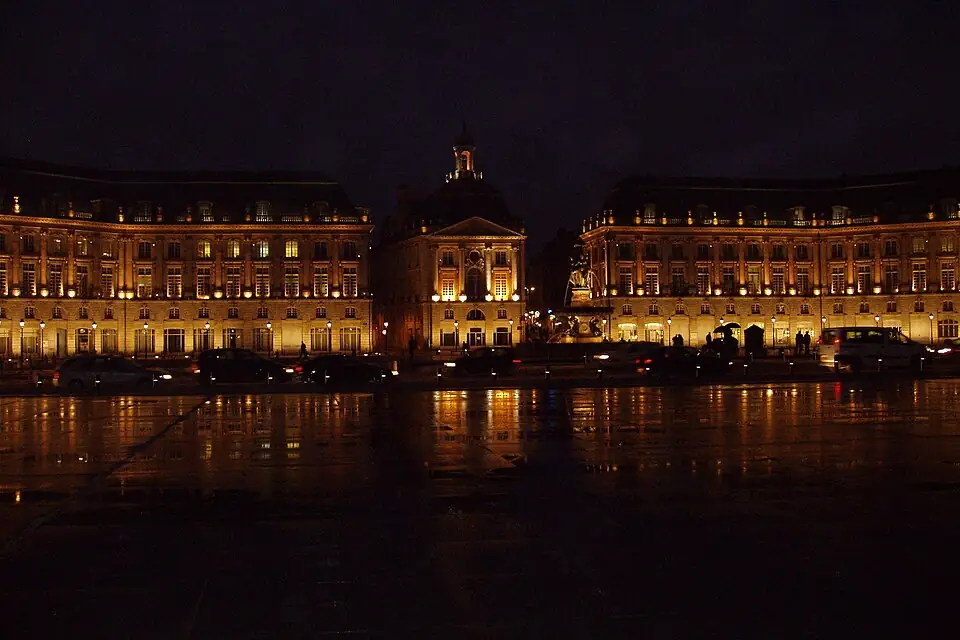
Place de la Bourse and the miroir d’eau. This is the shot you’ve seen: a perfectly symmetrical 18th-century facade reflected in a thin sheet of water on the quay opposite. The miroir d’eau is the world’s largest reflecting pool, and on a warm day kids and grown-ups both end up paddling in it as a fine mist rises off the granite. Go at dusk when the building lights up and the reflection doubles it.
Saint-André cathedral. A vast Gothic pile in the heart of town, with the separate Pey-Berland tower beside it. Climb the tower’s spiral stairs for the best rooftop panorama of Bordeaux’s uniform stone sea, well worth the modest entry.
The Pont de Pierre and the riverfront. Bordeaux’s first bridge across the Garonne, built under Napoleon, is best walked at golden hour for the view back at the spires. The quays themselves, freshly reclaimed as walking and cycling space, are the city’s living room, all joggers, skaters and families.
The markets. The Marché des Capucins is the city’s belly, the place to graze plates of fresh seafood and oysters from the bay, buy regional cheese, and eat like a local for a fraction of restaurant prices. Pair it with the Sunday morning market along the Chartrons quay.
Day trip: the Dune du Pilat and Arcachon Bay. This is the one not to skip. About an hour from the city, the Dune du Pilat is the tallest sand dune in Europe, a 100-metre wall of pale sand you climb for a view over the Atlantic on one side and a pine forest on the other. Below it, Arcachon Bay is all calm water, seafood shacks and oyster ports, an easy, beachy counterpoint to the city stone. Take the train to Arcachon, then a local bus or bike toward the dune. Go early in summer to beat both the heat and the crowds.
For wider planning across the country, see our best time to visit France guide.
Best Time to Visit Bordeaux
Bordeaux has a mild Atlantic climate, which is a polite way of saying summers are warm and the rest of the year can throw weather at you. Time it for the shoulder months and you get long evenings on the quays, lively markets and softer prices, all without the July-August crush. Here’s how the seasons stack up.
| Season | Weather | Crowds | Prices | Best for |
|---|---|---|---|---|
| Spring (Apr–Jun) | Mild, greening, occasional showers | Low to mid | Shoulder | Best overall, long light, calm streets |
| Summer (Jul–Aug) | Warm to hot, dry | Highest | Peak | Beaches, river life, festivals |
| Autumn (Sep–Oct) | Warm Sep, cooling Oct | Easing | Great value | Mild evenings, golden quays |
| Winter (Nov–Mar) | Grey, wet, mild-cold | Low | Lowest | Bargains, quiet museums, café days |
The best pick is June or September. June gives you the longest days and the riverfront at its liveliest; September keeps the warmth but drops the crowds and the prices, and the light on the limestone goes the colour of caramel about an hour before sunset. Skip high summer unless you specifically want the Arcachon beaches, when the day-trip trains get genuinely packed. Winter is cheap and atmospheric, but pack for grey.
Where to Stay in Bordeaux
Where you sleep changes the whole feel of a Bordeaux trip, because the city splits into distinct neighbourhoods that suit very different travellers. Stay in the old town and transport becomes almost unnecessary; stay near the station for half the price and expect a twenty-minute walk each way instead. Both work, depending on what matters more. Here’s the honest breakdown.
| Area | Vibe | Who it suits |
|---|---|---|
| Saint-Pierre (old town) | Medieval lanes, central, café-packed | First-timers who want to walk everywhere |
| Chartrons | Calm, creative, antique shops, riverside | Slow travellers, repeat visitors, market lovers |
| Triangle d’Or | Elegant, central, smart shopping | Style-focused stays, shorter trips |
| Around Gare Saint-Jean | Cheaper, busy, transit-handy | Budget travellers and TGV day-trippers |
Saint-Pierre is the natural pick for a first-timer: inside the historic core, steps from Place de la Bourse and the river, with lanes that are wall-to-wall café terraces. Chartrons trades a little distance for a quieter, more local feel and the best Sunday market on the quays. The Triangle d’Or is the polished, central option for smart hotels. And the streets around Gare Saint-Jean are noticeably cheaper and perfect for hopping out to Arcachon by train, though the immediate area is more functional than pretty. Compare current rates anytime on our hotels hub.
Frequently Asked Questions
What is the best time to visit Bordeaux?
Late May to June and September are the sweet spot: warm, long days, the riverfront at its best, and prices below the July-August peak. Spring is green and uncrowded; September stays mild into the evening. Winter is cheap and quiet but grey and wet.
How many days do you need in Bordeaux?
Two full days cover the historic centre on foot: Place de la Bourse, the cathedral, the Pont de Pierre and the markets. Add a third day for a trip out to the Dune du Pilat and Arcachon Bay, which is easy by train and well worth it.
Where should I stay in Bordeaux?
Saint-Pierre, the old town, is the most central and walkable base. Chartrons is calmer and creative; the Triangle d’Or is upscale and central; and the area around Gare Saint-Jean is cheaper and handy for trains, though less charming. Most visitors do best in Saint-Pierre.
Is Bordeaux walkable, and how do you get around?
The centre is very walkable and largely pedestrianised. For longer hops, the modern tram network (lines A, B, C and D) is fast and cheap, with lines C and B linking Gare Saint-Jean to the centre. A single ticket covers tram and bus.
How do I get from Bordeaux airport to the city?
The ‘30’Direct shuttle bus runs from Bordeaux-Mérignac airport to the centre and Gare Saint-Jean, or you can take tram A with a connection toward the centre. From Paris, the TGV reaches Bordeaux in about two hours, often the easiest option.
Is Bordeaux worth visiting if you don’t drink?
Absolutely. Bordeaux is a UNESCO-listed 18th-century city of grand stone facades, the famous miroir d’eau reflecting Place de la Bourse, riverside walks, food markets and café terraces, plus easy beach and dune day trips, all of which stand on their own.
Start Planning Your Bordeaux Trip
A half-day visit to Bordeaux has a habit of stretching into two, and the Dune du Pilat deserves its own afternoon rather than a rushed add-on. Bordeaux rewards the slow traveller: walk the quays, climb the Pey-Berland tower, graze the Capucins market, and ride the train out to the dune when the city stone starts to feel like enough. Time it for June or September, base yourself in Saint-Pierre, and let the rest happen on foot.
Compare prices now and lock in your dates:
Find cheap flights to Bordeaux | Compare Bordeaux hotel prices