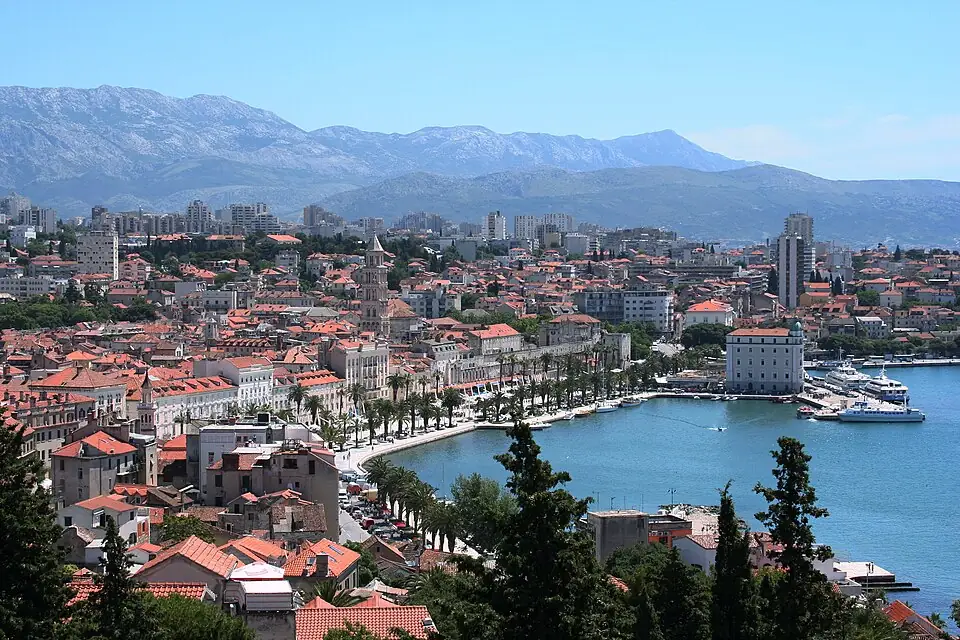
Quick Answer
- Best time to visit Split: late May–June and September: warm sea, lighter crowds, prices below the July–August peak.
- Where to stay: inside Diocletian’s Palace / Old Town for first-timers; Varoš for quiet charm; Bačvice for the beach; Žnjan for value.
- From SPU airport: take the shuttle bus or local bus 37 to the centre: far cheaper than a taxi, and then you walk.
- Island hop: Split is Dalmatia’s ferry hub: Jadrolinija ferries and catamarans to Hvar, Brač and Vis (book summer catamarans ahead).
- Don’t rush: Diocletian’s Palace, the cathedral bell tower, the Riva and Marjan hill are all on foot from your door.
Split, Where the Palace Is the City
Split is easy to treat as a quick overnight before catching a ferry to Hvar, dismissed as “just the port town.” That take misses the point entirely: a guesthouse booked here can turn out to be inside a 1,700-year-old Roman palace, with morning coffee from a café wedged against an emperor’s wall, in an “Old Town” that is Diocletian’s Palace itself, still lived in, still open to the sky.
So here’s the short version this Split travel guide is built around: come in late spring or September, sleep inside or right beside Diocletian’s Palace, get around entirely on foot, and use the ferry port to steal a day on Hvar or Brač. Do those four things and Split stops being “the place you pass through” and becomes the easy, sun-warmed, walkable Dalmatian base it actually is.
No car is needed, barely a map, and definitely no rush to catch the ferry out. The one thing most first-timers get wrong is treating Split as a transit stop instead of a destination, and the best part of this city is the part that gets walked straight past otherwise.
What to pack for Split
Four picks from our gear guides that suit this trip. Each card opens the live Amazon price; the links below lead to the full comparisons.
25 x 18 x 4 cm, 254 g, 2.1 L. Locking zips, a cut-resistant double-cable strap, an RFID passport pocket and a strap that clips to a chair. Reader’s Digest’s best crossbody for travel.
Check price on Amazon Live price on AmazonThe best value compression set going. A double-zip pulls the air out so a week of clothes shrinks to a few inches thick, and you get eight pieces (cubes plus a shoe and laundry bag) for roughly the price of one branded cube. The fabric is thin and the zips aren’t lifetime kit, but for the money nothing beats it.
Check price on Amazon Live price on AmazonThe reliable all-rounder: one USB-C and four USB-A ports, plugs for 200+ countries, and a built-in fuse with a spare. The adapter most people should buy.
Check price on Amazon Live price on AmazonModel A1259, 10,000mAh, about 37Wh, 215 g. Two phone charges in a jacket pocket, and small enough that the two-bank limit never becomes a question.
Check price on Amazon Live price on AmazonGetting Around Split
Here’s the thing most people overthink: getting around Split. You don’t need a car, you don’t need a transit pass, and you’ll use your feet for almost everything. The only rides you’ll take are the one in from the airport and the boats out to the islands.
And honestly? Don’t plan it too tightly. The whole centre is small enough to cross in fifteen minutes, the stone alleys are gorgeous, and the best things you’ll find are the ones you stumble into between the Palace and the sea.
Where to eat without overpaying takes the same instinct: follow the locals off the Riva, not the menus with photos:
- Graze the Green Market. The open-air Pazar beside the Palace does fruit, olives, cheese and burek for a few euros, a perfect beach or Marjan-hill picnic, eaten the way locals shop.
- Find a back-lane konoba. Step one street off the tourist drag and a family-run konoba does grilled Adriatic fish, peka slow-roasts and Dalmatian home cooking: heartier, cheaper and far more memorable than the Riva terraces.
- Try a slice of viška pogača. This savoury Dalmatian flatbread from nearby Vis is sold by the slice in bakeries, a cheap, genuinely local snack to grab on the move.
- Coffee on the Riva, the local way. A long, slow morning coffee watching the harbour is the Dalmatian pastime; a kava at a side-street café costs far less than the front-row Riva terraces and feels just as good.
What Not to Miss
You can’t do all of Split and the islands in one short trip, so aim for a handful done well rather than a checklist done badly.
- Diocletian’s Palace and the cellars. Wander the living Old Town inside the Roman walls, then drop into the vast, cool substructures (cellars) beneath: the best-preserved part of the original palace, and a welcome break from the sun.
- The Cathedral of St Domnius bell tower. Climb the Romanesque bell tower for a heart-stopping view over the Palace rooftops, the harbour and the islands beyond: the single best panorama in the centre.
- The Riva promenade. Split’s palm-lined waterfront is where the whole city strolls at dusk; grab a coffee, watch the ferries come and go, and let the evening unfold.
- Marjan hill viewpoint. A short climb from the Old Town’s western edge through pine forest delivers the postcard view back over the Palace and the Adriatic, free, and best near sunset.
- A Hvar or Brač island day trip. Catamaran to Hvar town or ferry to Brač for the famous Bol (Zlatni Rat) beach: the easiest, most rewarding day out from the harbour.
- Trogir and Krka nearby. UNESCO-listed Trogir is a tiny stone island town 30 minutes up the coast, and the Krka waterfalls make a stunning day trip inland: both easy without your own car.
Best Time to Visit Split
Split is a year-round city, but the season you pick changes the heat, the crowds and the ferry queues far more than the brochure shots suggest. The short answer: the shoulder months win, hands down. Here’s how the seasons actually compare.
| Season | Weather | Crowds | Prices | Best for |
|---|---|---|---|---|
| Spring (Apr–Jun) | Warming, blossoming, 16–26°C | Building | Mid, rising into June | Café terraces, the Palace, the all-round sweet spot |
| Summer (Jul–Aug) | Hot, dry, 28–34°C | Heaviest | Peak | Sea swimming, island ferries, but heat, crowds, full ferries |
| Autumn (Sep–Oct) | Warm, golden, 18–27°C | Easing | Good value | Warm sea into October, calmer Old Town, soft prices |
| Winter (Nov–Mar) | Mild, often grey, 8–14°C | Low | Cheapest | Quiet stone lanes, bargains, but reduced ferries |
A couple of things the table can’t tell you: the Adriatic stays swimmable well into September, so early autumn is the secret weapon: warm water and a calm Old Town. July and August are genuinely hot and the ferries to Hvar can sell out by mid-morning. And winter is cheap and atmospheric, but island sailings thin right out, so it’s a city break, not an island-hopping one.
Where to Stay in Split
Split is compact and the centre is car-free, so where you sleep matters less for distance and more for atmosphere, and for whether you wake up inside Roman walls or a five-minute walk from the sea. Here’s how the classic bases compare.
| Neighbourhood | Vibe | Roughly | Best for |
|---|---|---|---|
| Diocletian’s Palace / Old Town | Historic, lively, car-free | 90–180€/night | First-timers, atmosphere, walking to everything |
| Varoš | Quiet stone lanes, village-like | 70–140€/night | Charm, calm, a short walk to the Riva |
| Bačvice | Beachside, buzzy, modern | 80–160€/night | The city beach on your doorstep |
| Žnjan | Newer, residential, spread out | 60–120€/night | Value, apartments, longer walk or a quick bus |
First-timers should sleep inside or right beside Diocletian’s Palace and just walk everywhere. You’re in the living Old Town, with the cathedral, the Riva and the markets all out your door. Varoš, the old fishermen’s quarter just west, trades a little distance for quiet stone lanes and softer rates. Bačvice is the pick if you want the city beach first thing, and Žnjan is the value play: newer apartments, a longer walk or a short bus in. Compare live rates anytime on our hotels hub.
Frequently Asked Questions
What is the best time to visit Split?
Late May to June and September are the sweet spot: warm sea, long days, café terraces buzzing and prices below the July–August peak. High summer is hot and crowded, with packed ferries and top hotel rates. Spring and autumn shoulders give you the Old Town and the islands without the crush.
Where should I stay in Split for the first time?
Stay inside or beside Diocletian’s Palace and the Old Town to be in the heart of everything on foot. Varoš adds quiet stone-lane charm a short walk from the Riva, Bačvice puts you next to the city beach, and Žnjan trades a longer walk for newer apartments and value. Pick one base and wander.
How do I get from Split airport (SPU) into the centre?
The Croatia Airlines shuttle bus runs from SPU to the main bus station by the harbour in about 30–50 minutes, and local bus 37 is the cheaper, slower option via Trogir and Kaštela. Both are far cheaper than a taxi, and the centre is small enough that you walk everywhere once you arrive.
Can you do island day trips from Split?
Yes. Split is Dalmatia’s ferry hub. Jadrolinija car ferries and faster catamarans run to Hvar, Brač and Vis daily, with Brač’s Bol beach and Hvar town the classic day trips. Book summer catamaran seats ahead, as they sell out; car ferries are slower but easier to walk on for a day return.
Is Split walkable, or do I need transport?
Split’s centre is wonderfully walkable: Diocletian’s Palace is the living Old Town, so you sleep, eat and sightsee inside Roman walls on foot. You’ll only want a bus or taxi for the airport, the Žnjan beaches or a trailhead. Marjan hill and the Riva promenade are both an easy stroll from the Palace.
How long should you spend in Split?
Two to three nights covers Split itself comfortably (the Palace, the cathedral bell tower, the Riva and Marjan hill) with a full day left for an island. Add a night or two if you want both Hvar and Brač, or a side trip to Trogir and the Krka waterfalls. Many travellers use Split as a Dalmatian base.
Start Planning Your Split Trip
Get the season and the base right and Split is far more than a ferry port. It’s a sun-warmed, walkable Roman city with the islands on its doorstep. One night before Hvar is rarely enough; the Palace, the bell tower view and a slow coffee on the Riva are reason enough to stay three. Aim for the shoulder months, sleep inside or beside the Palace, walk everything, and steal a day on the islands.
Compare prices now and lock in your dates:
Find cheap flights to Split | Compare Split hotel prices
Planning the wider trip? See our Croatia travel guide and browse more stays on the hotels hub.