Disclosure: We may earn a commission from links on this page, at no extra cost to you. How we earn
This article contains affiliate links. If you make a booking through these links, we may earn a commission at no extra cost to you. About & Affiliate Disclosure
Quick Answer
- Shoes off before entering homes, pagodas and many guesthouses - look for the shoe rack by the door.
- Give and receive with two hands - money, gifts, business cards, even change from a vendor.
- Cover shoulders and knees at temples - the Ho Chi Minh Mausoleum enforces this strictly and closes Mondays and Fridays.
- Cross streets at a slow, steady walk - never stop or bolt once you’ve stepped off the curb.
- Bargain at markets, not shops - counter at around 30-50% of the asking price; supermarkets and malls are fixed-price.
- No-alcohol angle: build evenings around cà phê culture, night markets, lakeside walks and lantern-lit streets - not a bar scene.
The Street-Crossing Trick Nobody Explains Before You Land
Hanoi’s Old Quarter looks like a river of scooters with no traffic lights in sight, and standing frozen at the curb waiting for a gap that never fully opens is the single most common first-morning mistake visitors make. The trick nobody explains in advance: the street isn’t chaos to out-think, it’s a system to join at a steady pace, and motorbikes flow around a walker who commits rather than one who hesitates.
None of the mistakes below will get you shouted at or thrown out of a temple. Vietnam is famously patient with visitors who are clearly trying. But get the shoes, the two hands, the bargaining and the crossing technique right, and you go from the tourist getting quietly corrected to the one who’s already found the good phở stall down the alley everyone else walks past.
Shoes, Homes and Pagodas: The Rule You’ll Use Daily
This is the etiquette rule you’ll actually apply the most, because it comes up multiple times a day, not just at famous sights.
Giving, Receiving and the Two-Hand Rule
Money, gifts, business cards and even your ID at a hotel front desk are all handled the same way here, and it’s an easy habit to build fast.
- Use two hands, or your right hand supported by your left, when handing something to someone or receiving something back - a single outstretched hand can read as careless, even if no one says anything.
- This applies to change from a market stall, a business card at a hotel check-in, and any gift you bring for a host - it’s a small gesture that Vietnamese hosts notice and appreciate.
- It costs nothing to do and nothing to forget, but doing it consistently is one of the fastest ways to signal you’ve made an effort, which tends to earn warmer service in return.
Temple Dress Codes: The Ho Chi Minh Mausoleum Is the Strict One
Most of Vietnam’s pagodas are relaxed about dress as long as you’re reasonably covered, but the country’s most-visited site runs a genuinely strict line.
| Site | Dress code | Entry | Hours (2026) |
|---|---|---|---|
| Ho Chi Minh Mausoleum | Strict - shoulders and knees covered, no shorts, sleeveless tops or flip-flops; silence and no photos inside | Free | Tue-Sun, summer (Apr-Oct) around 7:30-10:30am, winter (Nov-Mar) around 8:00-11:00am; closed Mon, Fri, and roughly 2 months yearly for maintenance |
| Temple of Literature | Modest dress expected, not strictly enforced at the gate | Around ₫70,000 adult (~$2.70), confirm on-site as figures vary by source | Around 8:00am-5:00pm |
| Local pagodas (Old Quarter, citywide) | Shoulders/knees covered, shoes off inside | Usually free or small donation | Vary; mornings are quietest |
The Mausoleum’s guards will turn away visitors in shorts or tank tops, and there’s no vendor renting cover-ups at the gate the way some sites do elsewhere - bring a light scarf or a spare layer in your day bag if the Mausoleum is on your itinerary, since it also closes for roughly two months most years for annual maintenance (recently around June-August).
Bargaining at Markets Without the Awkwardness
Bargaining is expected in Vietnam’s markets, but it works best as a friendly back-and-forth, not a standoff.
- Vendors in tourist-heavy markets often quote 50-70% above what a local would pay, so opening your counter-offer at around 30-50% of the asking price isn’t rude, it’s the normal opening move.
- Smile, stay relaxed, and expect two or three rounds before landing somewhere in the middle - raising your voice or looking annoyed tends to stall the negotiation, not speed it up.
- Being willing to actually walk away is the real leverage - vendors often call you back with a better number once you start leaving, and if they don’t, the original stall down the row usually has the same item.
- Fixed-price stores, supermarkets and convenience chains don’t bargain at all - trying it there just confuses the cashier.
- Bring cash in reasonably small denominations; Vietnam’s dong runs into the hundreds of thousands for everyday purchases (a ₫1,000,000 note works out to around $38 at the current rate near ₫26,000 per dollar), so double-check the zero count before handing over a note or accepting change.
Crossing the Street: The One Skill Every Guidebook Undersells
This is less an etiquette rule than a survival skill, but it’s the single thing that unsettles first-time visitors more than anything else on this list - and it has an actual technique.
- Step off the curb at a slow, steady, predictable pace and keep walking in a straight line across the street - don’t stop halfway, don’t speed up, don’t dart back.
- Motorbikes are reading your trajectory and adjusting their own path around you as you move; a sudden stop is what actually causes a near-miss, not the initial step into traffic.
- Cross with a local or alongside a small cluster of other pedestrians your first day or two if it feels like too much to judge alone - you’ll pick up the rhythm faster by watching than by reading about it.
- Look both ways even on streets that look one-way - motorbikes routinely flow against traffic direction on quieter lanes.
- Hanoi’s Old Quarter has some of the densest, narrowest examples of this in the country; once you’ve done it there, wider boulevards elsewhere feel easy by comparison.
Small Things That Add Up: Heads, Feet and a Few Words
A handful of smaller habits round out the list, and Vietnamese hosts notice when visitors get them right.
- Don’t touch someone’s head, even a child’s, even affectionately - the head carries spiritual significance in Vietnamese belief, and patting or ruffling hair can land wrong even when meant warmly.
- Don’t point the soles of your feet at people, a Buddha statue or a temple altar - when sitting on the floor at a pagoda, tuck your feet under or to the side rather than stretching them out toward the shrine.
- Xin chào (hello) and cảm ơn (thank you) go a long way even with imperfect pronunciation - most vendors and hosts light up at the attempt.
- Tipping isn’t traditional but is increasingly welcomed in tourist-facing restaurants and cafés - rounding up or leaving ₫10,000-20,000 for good service is a kind gesture, not an obligation, though tour guides and drivers on multi-day trips are the one context where a modest tip at the end is genuinely expected.
Evenings Are Built Around Cà Phê, Not a Bar Scene
Vietnam’s evening culture runs on coffee, food and lantern light rather than anything you’d find in a Western nightlife guide, and it’s genuinely one of the best parts of visiting.
- Cà phê culture is the real social institution - egg coffee (cà phê trứng), a Hanoi specialty with a whipped egg-yolk custard on top, and strong drip coffee over condensed milk (cà phê sữa đá) are what locals actually linger over for hours at a sidewalk stool.
- Night markets (Hanoi’s Old Quarter weekend market, Hoi An’s lantern-lit riverside stalls) are where the evening energy lives - browse, eat street food standing up, and let the crowd carry you along.
- Phở and bánh mì are the street-food anchors, not a side note: a bowl of phở in Hanoi runs around ₫40,000-50,000 (
$1.50-1.90) and a bánh mì around ₫20,000-50,000 ($0.80-2) depending on the filling, both best eaten at a plastic-stool stall rather than a sit-down restaurant. - Hoan Kiem Lake at dusk, with the Turtle Tower silhouette and the old French Quarter lights coming on, is a genuine evening destination on its own - a slow lap of the lake covers most of what makes an evening in Hanoi memorable, no bar required.
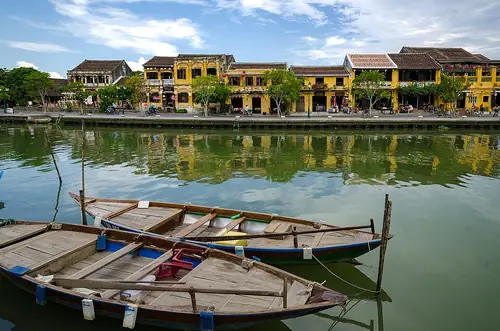
- Hoi An’s lantern evenings on the riverside, with paper lanterns released onto the water, are the country’s most photographed alcohol-free night scene for good reason.
Visa Rules: What’s Actually True in 2026
Here’s the etiquette-adjacent question every visitor eventually has to sort out, and getting it wrong is expensive, not just embarrassing: Vietnam’s entry rules depend entirely on your passport. UK, French, German, Italian and Spanish citizens get a unilateral 45-day visa exemption, valid from March 2025 through March 2028, with multiple visits allowed. US, Canadian and Australian citizens are not on that exemption list and need Vietnam’s e-visa - apply only at the official portal, evisa.gov.vn, which runs around $25 for single entry or $50 for multiple entry, is valid 90 days, and takes around 3 business days to process. Third-party visa sites routinely charge two to three times the official fee for the same document, so bookmark the government URL directly rather than clicking a search-ad result.
Getting Around and Staying Connected
Good etiquette extends to how you actually move through Vietnam and stay reachable while you do.
From Noi Bai Airport (HAN) into central Hanoi, Bus 86 runs around ₫45,000 (~$1.85), flat fare paid in cash, taking roughly 50-55 minutes to Hanoi Railway Station near the Old Quarter. A Grab car into the Old Quarter runs around $9-12 depending on demand and time of day, while a metered taxi typically costs more, around $23-25. Once in the city, our full Vietnam getting-around guide covers the Reunification Express, open-tour buses and domestic flights in more detail.
Staying connected matters for reading Grab maps, translating menus and looking up bus routes on the fly. An eSIM landed before departure runs on Vietnam’s Viettel or Vinaphone networks from around $4 for a short trip - see our Vietnam eSIM guide for current plans rather than hunting for a SIM counter at the airport.
- Activate before you fly: data works on arrival
- Plans for 200+ countries from a few dollars
- Keep your number; no physical SIM swap
Frequently Asked Questions
What are the most common mistakes tourists make in Vietnam?
The most common mistakes are keeping shoes on when entering a home or pagoda, handing over money or a gift with one hand, dressing in shorts and a tank top at the Ho Chi Minh Mausoleum, freezing or running when crossing a street full of motorbikes, and accepting a market vendor’s first price without countering. None of these cause real offense, but avoiding them makes daily life smoother and often cheaper.
Do you need a visa for Vietnam in 2026?
It depends on your passport. UK, French, German, Italian and Spanish citizens get 45 days visa-free under Vietnam’s exemption policy, valid through March 2028. US, Canadian and Australian citizens are not on that list and need an e-visa, applied for only at the official evisa.gov.vn portal - it runs around $25 for single entry or $50 for multiple entry, valid 90 days, with processing taking around 3 business days.
How do you cross the street safely in Vietnam?
Step off the curb at a steady, predictable pace and keep walking in a straight line - don’t stop, don’t run, and don’t change direction mid-crossing. Motorbikes are watching your path and adjusting around you; a sudden stop or dart is what actually causes a collision. Cross with a local or a small group your first time if it feels overwhelming, and always look both ways since some streets carry unexpected one-way flows of bikes.
Do you tip in Vietnam?
Tipping is not traditional but is increasingly appreciated in tourist-facing spots. Rounding up a restaurant bill or leaving 10,000-20,000 dong for a good meal is a kind gesture, not an obligation. Tour guides and drivers on multi-day trips are the exception - a small tip at the end is customary and genuinely expected in that specific context.
How much should you bargain at Vietnamese markets?
Vendors in tourist markets often open at 50 to 70 percent above what a local would pay, so a starting counter-offer of 30 to 50 percent of the quoted price is normal, not rude. Stay smiling and polite, expect to meet somewhere in the middle after two or three rounds, and be genuinely willing to walk away - that’s usually what gets the real price. Fixed-price shops and supermarkets don’t bargain at all.
Can you touch someone’s head or point your feet in Vietnam?
Avoid both. The head is considered spiritually significant in Vietnamese culture, so patting a child’s head or ruffling someone’s hair, even affectionately, can feel wrong to locals. Pointing the soles of your feet at a person, a Buddha statue, or a temple altar is also considered disrespectful - tuck your feet under or to the side when sitting on the floor at a pagoda.
Travel Vietnam Like You’ve Done This Before
Get the basics right - shoes off, two hands, shoulders covered at the Mausoleum, a steady walk across the street, and a fair opening bargain at the market - and the rest falls into place by watching what the person next to you does. Vietnam doesn’t expect visitors to get everything right on day one; it’s the willingness to adjust that turns a checklist trip into the kind of evening lap around Hoan Kiem Lake you didn’t want to end.
Find cheap flights to Vietnam | Compare Hanoi hotels
Keep planning with our Vietnam pillar guide, Vietnam itinerary, Vietnam budget guide and Vietnam eSIM guide. Heading to specific cities? See our guides to Hanoi, Ho Chi Minh City, Hoi An, Da Nang and Ha Long Bay. Compare more hotels, grab a data eSIM, check flights or look into travel insurance before you land.