Quick Answer
- Best time to visit Da Nang: February to August: dry, calm seas and beach-ready, with June and July the warmest and busiest.
- Where to stay: My Khe beachfront for the sand; the riverside centre near the Dragon Bridge for food and buzz; An Thuong for value.
- From the airport: DAD sits inside the city: roughly 10 minutes to the centre by Grab, no train needed.
- Getting around: Grab cars and bikes are cheap and the fare’s fixed up front; the city is flat and easy.
- Use it as a base: Hoi An is ~45 min south; the Hai Van Pass train to Hue gives huge coastal views for a normal ticket.
Da Nang, the Easy Way to Do Central Vietnam
Da Nang gets treated as a transit hub for a night before rushing on to Hoi An, and it deserves far more than that. The airport sits ten minutes from a beach so long and clean it barely looks real, the food costs less than a coffee back home, and every sight worth seeing turns out to be a short, cheap ride away. The city most itineraries plan to skip is often the one travelers least want to leave.
So here’s the short version this Da Nang travel guide is built around: come in the dry season (roughly February to August), sleep near My Khe beach or by the river in the centre, get the Grab app working before you land, and use the city as a base for Hoi An, the Marble Mountains and the train ride to Hue. Do that and Da Nang stops being a stopover and becomes the most relaxed, best-value stretch of any central Vietnam trip.
You don’t need a packed itinerary here. You need to land in the right months, pick the right slice of coast to sleep on, and not overthink the rest. It’s beach mornings and noodle lunches with world-class day trips bolted on. Start with the season, because it changes this trip more than anything else you’ll decide.
What to pack for Da Nang
Four picks from our gear guides that suit this trip. Each card opens the live Amazon price; the links below lead to the full comparisons.
360-degree memory foam with asymmetrical sides, so you pick which side gets the most support instead of getting the same generic curve everywhere. It was the single most-purchased travel product among Travel + Leisure readers in 2025. The catch: even compressed to about 60% of its size in the included bag, it’s still bulkier than an inflatable.
Check price on Amazon Live price on Amazon61 x 122 cm, listed at 120 g in navy, snap loop and a ventilated carry bag. Rainleaf says it absorbs five times its own weight, and it comes in six sizes. The one most travelers should buy first.
Check price on Amazon Live price on AmazonThe reliable all-rounder: one USB-C and four USB-A ports, plugs for 200+ countries, and a built-in fuse with a spare. The adapter most people should buy.
Check price on Amazon Live price on AmazonModel A1259, 10,000mAh, about 37Wh, 215 g. Two phone charges in a jacket pocket, and small enough that the two-bank limit never becomes a question.
Check price on Amazon Live price on AmazonGetting Around Da Nang
Here’s the good news most first-timers don’t expect: the airport is in the city, so you skip the long, pricey transfer that eats into most Asian arrivals. From wheels-down to a beachfront check-in is often under twenty minutes.
And honestly? You’ll spend less time in transit here than almost anywhere in Vietnam. Beach in the morning, a noodle lunch in An Thuong, the Marble Mountains in the afternoon, and the Dragon Bridge after dark: all without a single long journey.
What Not to Miss
You don’t have to choose between the beach and the sights in Da Nang, the best days mix both. Aim for a handful done well.
- My Khe beach is the headline: kilometres of clean sand, calm dry-season water, and sunrise walks that are worth the early alarm. Loungers and casual seafood shacks line the back.
- The Marble Mountains are five limestone-and-marble hills riddled with caves, pagodas and viewpoints, a short ride south of the city: climb early before the heat and the crowds.
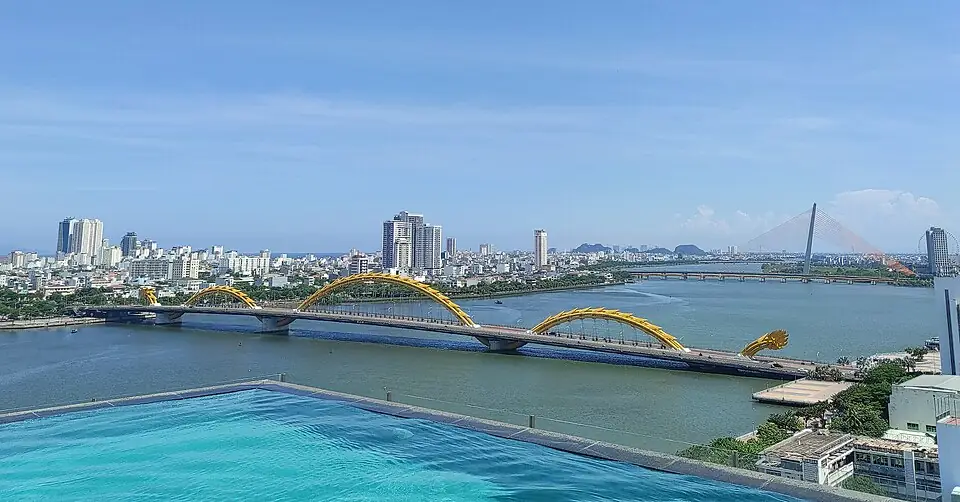
- The Dragon Bridge breathes real fire and water on weekend nights (typically Saturday and Sunday around 9pm): grab a riverside spot to watch the show, free and genuinely fun.
- Ba Na Hills and the Golden Bridge (the famous bridge held up by two giant stone hands) sit in the hills inland; it’s touristy and a full day, but the cable car and the views deliver.
- Day trips to Hoi An and the Hai Van Pass are the reason to base here: Hoi An’s lantern-lit old town by night, and the pass road or train ride for the coastal views.
The quiet wins are free: sunrise on My Khe, the breeze on the Dragon Bridge at dusk, and a bowl of mi quang at a plastic-stool stall where you’re the only foreigner in sight.
Best Time to Visit Da Nang
Da Nang runs on two seasons, and they’re night and day for a beach trip. The short answer: aim for the dry stretch, February to August, and treat the autumn as a gamble. Here’s how the seasons actually compare.
| Season | Weather | Sea & beach | Crowds | Best for |
|---|---|---|---|---|
| Spring (Feb–Apr) | Warm, dry, 24–30°C | Calm, swimmable | Building | The sweet spot, beach days, mild heat, good value |
| Summer (May–Aug) | Hot, dry, 30–35°C | Warm and calm | Heaviest (Jun–Jul) | Full beach season, festivals, long sunny days |
| Autumn (Sep–Nov) | Wet, humid, storms | Rough, often closed | Low | Cheapest, but heavy rain and flood risk (esp. Oct–Nov) |
| Winter (Dec–Jan) | Cooler, showery, 20–24°C | Choppy, cooler | Low | Quiet city breaks, cheaper rooms, fewer beach days |
A few things the grid can’t tell you: the rains don’t drizzle, they dump: central Vietnam’s wettest months are October and November, when streets can flood and the coast road shuts. If you only care about price, those wet months are the cheapest the city gets, but you’re rolling the dice on the weather. The cleverest weeks are the shoulders, late February and August, when the beach still delivers but the high-season crush hasn’t peaked.
Where to Stay in Da Nang
Da Nang stretches along the river on one side and a vast beach on the other, with a bridge or two stitching them together. Where you sleep is really a choice between sand, city, or value, and none of them is far from the others. Here’s how the main bases compare.
| Area | Vibe | Roughly | Best for |
|---|---|---|---|
| My Khe beachfront | Resort, sand on the doorstep | $40–120/night | Swimmers, sunrise walks, easy beach days |
| Riverside / city centre (Dragon Bridge) | Urban, restaurants, markets | $30–90/night | Food, nightlife, the weekend bridge show |
| An Thuong (tourist quarter) | Walkable, cheap eats, backpacker-friendly | $20–60/night | Value, solo travellers, café-and-street-food crawls |
First-timers do best sleeping on My Khe and waking up to the beach: the sand runs for kilometres and the sea is calm in the dry season. The riverside centre near the Dragon Bridge is the pick if you’d rather have restaurants, markets and the weekend fire-and-water show on your doorstep than sand. An Thuong, the little tourist quarter tucked just behind My Khe, is the value play: walkable, packed with cheap eateries and small hotels, and a five-minute stroll from the beach anyway. Compare live rates anytime on our hotels hub.
Frequently Asked Questions
What is the best time to visit Da Nang?
February to August is the sweet spot: dry days, calm seas and beach weather, with the warmest, busiest stretch in June and July. September to December is the wet season, with heavy rain and a real flood risk in October and November. Visit in the dry months for the beach; the shoulder weeks of February and August give you good weather with thinner crowds.
Where should I stay in Da Nang?
My Khe beachfront is the obvious base for sun, sand and easy swims. The riverside city centre near the Dragon Bridge keeps you close to restaurants, markets and nightlife. An Thuong, the tourist quarter just behind My Khe, is the budget-friendly, walkable pick with cheap eats and small hotels. Pick one and you can reach the rest in a short Grab ride.
How do I get from Da Nang airport into the city?
Da Nang International Airport (DAD) sits right inside the city, so the centre is roughly a 10-minute drive and the My Khe beach hotels are about 15 minutes. Book a Grab car on the app for a fixed, low fare, or take a metered taxi. There is no train or metro link. You simply do not need one when the airport is this central.
Is Da Nang a good base for day trips?
Yes. It is one of central Vietnam’s best bases. Hoi An’s lantern-lit old town is about 45 minutes south by Grab or bus. The Marble Mountains are halfway there. North, the scenic train over the Hai Van Pass to Hue gives you huge coastal views for the price of a normal ticket, and Ba Na Hills with the Golden Bridge is a day trip inland.
How do I get around Da Nang?
Grab is the default: cheap cars and motorbike taxis booked on the app, with the fare fixed before you ride. The city is flat and spread along the river and the beach, so it is easy to cover. Many travellers rent a motorbike to explore the coast, though traffic takes nerve. For Hoi An and Hue, use Grab, the bus or the train.
What should I eat in Da Nang?
Da Nang is a food city. Try mi quang (turmeric noodles with pork, shrimp and a crunch of peanuts and rice cracker), banh xeo (crispy savoury pancakes you wrap in herbs), and fresh seafood at the casual places lined up near My Khe beach. Street stalls and local markets are where the best and cheapest food is, follow the local queue.
Start Planning Your Da Nang Trip
Get the season and the base right and Da Nang quietly becomes the easiest, best-value part of any central Vietnam trip. Give it more than a single night: the beach, the food and the day trips make the case on their own. Aim for the dry months, sleep near My Khe or the river, lean on Grab, and let the train to Hue and the run to Hoi An do the heavy lifting.
Compare prices now and lock in your dates:
Find cheap flights to Da Nang | Compare Da Nang hotel prices
Planning the wider trip? See our best time to visit Vietnam guide and browse more stays on the hotels hub.