Quick Answer
- Best time to visit Chiang Rai: November to February: cool, dry, clear skies, perfect for temples and tea hills.
- Avoid: March–April, the hazy burning season, when smoke from field-clearing hides the mountains.
- Where to stay: the city centre near the Night Bazaar/clock tower for first-timers; riverside for calm; outskirts for resort space.
- Getting there: the ~3-hour bus from Chiang Mai, or fly into CEI airport (~15 min from town).
- Don’t miss: the White Temple (Wat Rong Khun), the Blue Temple, the Black House, and the Golden Triangle.
Chiang Rai, Beyond the White Temple Photo
Everyone shows up in Chiang Rai for one photo: the dazzling white, mirror-flecked temple that looks like a sugar palace from a dream. A late-March trip, though, can mean walking out of the airport into a grey wall of haze and spending the first afternoon wondering where the famous northern mountains went. They’re right there, just hidden behind burning-season smoke.
So here’s the short version this Chiang Rai travel guide is built around: come between November and February for cool, clear skies, base yourself in the city centre near the Night Bazaar, and budget half a day with a tour, Grab or scooter to reach the temples scattered outside town. Do that and Chiang Rai turns from a one-photo stopover into the calm, mountain-edged, genuinely magical corner of northern Thailand it actually is.
You don’t need a week here or a packed itinerary. You need to land in the right season, sleep somewhere walkable, and not assume the White Temple is around the corner from your hotel. It isn’t. The rest is tea hills, riverside mornings and three of the strangest, most beautiful temples in Thailand. The timing mistake above is the one almost every first-timer makes.
What to pack for Chiang Rai
Four picks from our gear guides that suit this trip. Each card opens the live Amazon price; the links below lead to the full comparisons.
360-degree memory foam with asymmetrical sides, so you pick which side gets the most support instead of getting the same generic curve everywhere. It was the single most-purchased travel product among Travel + Leisure readers in 2025. The catch: even compressed to about 60% of its size in the included bag, it’s still bulkier than an inflatable.
Check price on Amazon Live price on AmazonThe cheapest way to find out whether you even like compression socks: three knee-high pairs in 15-20 mmHg, the range most often recommended for flying.
Check price on Amazon Live price on AmazonThe reliable all-rounder: one USB-C and four USB-A ports, plugs for 200+ countries, and a built-in fuse with a spare. The adapter most people should buy.
Check price on Amazon Live price on AmazonModel A1259, 10,000mAh, about 37Wh, 215 g. Two phone charges in a jacket pocket, and small enough that the two-bank limit never becomes a question.
Check price on Amazon Live price on AmazonGetting Around Chiang Rai
Here’s the thing first-timers underestimate: the temples that put Chiang Rai on the map aren’t in Chiang Rai. They’re scattered in the countryside around it, so a little planning saves you a wasted morning.
And honestly? If you’re comfortable on two wheels, a scooter is the most freeing way to do the temple loop and the tea hills: just ride defensively, wear the helmet, and check the day’s air quality before you set off in the hot season.
What Not to Miss
You can see Chiang Rai’s headline sights in two or three unhurried days. Aim for these.
- Wat Rong Khun (the White Temple) is the one everyone comes for, a glittering, all-white modern temple covered in mirrored glass, with a surreal bridge and an interior of unexpected pop-culture murals. Go early to beat the tour buses.
- Wat Rong Suea Ten (the Blue Temple) is the cobalt-and-gold counterpoint a short ride from the centre: smaller, less crowded, and stunning in the late-afternoon light.
- The Black House (Baan Dam) is the dark, strange museum-complex of teak halls filled with bones, hides and carvings: the deliberate shadow to the White Temple’s light.
- The Golden Triangle viewpoint marks where Thailand, Laos and Myanmar meet across the Mekong, a scenic, photogenic day trip with river views and the Hall of Opium museum nearby.
- Hill-tribe villages and tea hills around Mae Salong and Doi Mae Salong reward the drive up with terraced tea plantations, mountain panoramas and a cooler, slower mood far from the crowds.
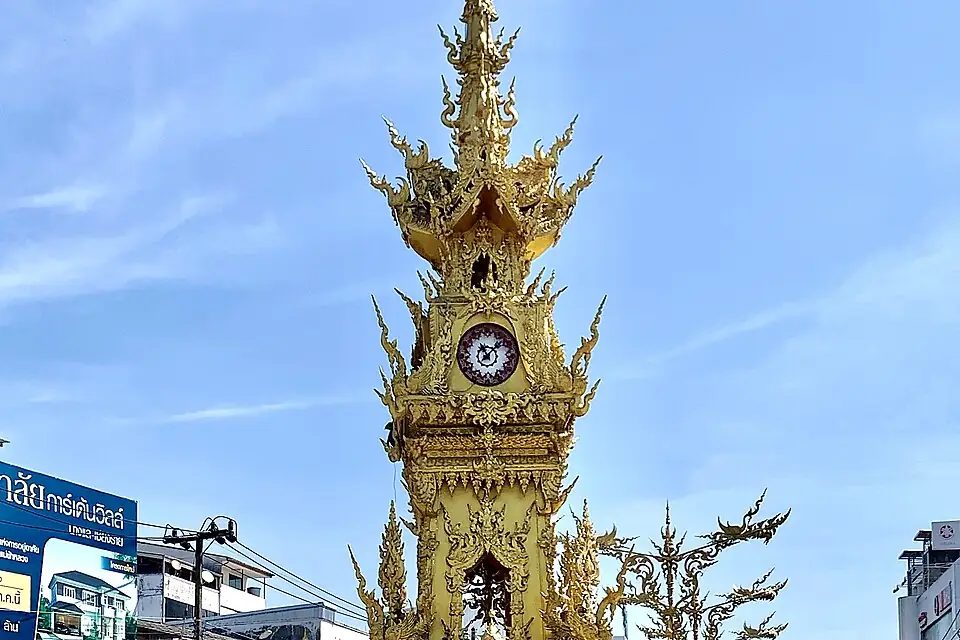
The quiet wins are free too: a slow morning along the Kok River, the clock tower’s hourly light show after dark, and the mountain air the moment the haze lifts in cool season.
Best Time to Visit Chiang Rai
Chiang Rai sits in the mountains of the far north, so the season you pick changes the air, the views and the comfort more than anywhere on the beaches. The short answer: the cool, dry months win, and there’s one stretch to actively dodge. Here’s how the seasons actually compare.
| Season | Weather | Air & views | Crowds | Best for |
|---|---|---|---|---|
| Cool & dry (Nov–Feb) | Cool, clear, 15–28°C | Crisp, clear mountain views | Highest (peak) | Temples, tea hills, everything, the sweet spot |
| Hot & hazy (Mar–Apr) | Hot, smoky, 25–38°C | Heavy burning-season haze | Low | Cheapest, but skies and air are poor |
| Green/rainy (May–Oct) | Warm, wet, 24–32°C | Lush, green, washed-clean after rain | Lowest | Fewest crowds, vivid scenery, afternoon downpours |
The detail worth circling: the burning season (roughly March into April) is when farmers clear fields across the north and air quality drops hard: the mountains vanish behind smoke and sensitive travellers feel it. If your dates are flexible, build the trip around December or January for the clearest skies and the cool-season festivals. The rainy season isn’t a write-off either; downpours come in short afternoon bursts, the landscape is at its greenest, and rooms are cheapest.
Where to Stay in Chiang Rai
Chiang Rai is small and the centre is genuinely walkable, so where you sleep is more about pace than distance. The city clusters around the clock tower and the Night Bazaar; from there it spreads out to the river and up toward the hills. Here’s how the classic bases compare.
| Area | Vibe | Best for |
|---|---|---|
| City centre (Night Bazaar / clock tower) | Walkable, lively, central to food | First-timers, night markets, no car needed |
| Riverside (Kok River) | Quieter, scenic, leafy | Couples, slow mornings, sunset views |
| Outskirts & hills (toward Wat Rong Khun) | Resort-style, spacious, calm | Pools, space, drivers/scooter riders |
If it’s your first time and you’ve got two or three nights, base yourself in the city centre. You’ll walk to the Night Bazaar food court and the Saturday walking street, and you’re a short Grab from everywhere else. The riverside is the romantic, quieter pick if you don’t mind hopping a songthaew into town for dinner. The outskirts make sense only if you’ve got wheels and want a pool and space over walkability. Compare live rates anytime on our hotels hub.
Frequently Asked Questions
What is the best time to visit Chiang Rai?
November to February is the sweet spot: cool, dry, clear-skied weather that’s perfect for temple-hopping and the tea hills. March and April are the hazy burning season, when farmers clear fields and the air quality drops sharply. The green, lush rainy season runs roughly June to October with afternoon downpours but the fewest crowds.
Where should I stay in Chiang Rai for the first time?
The city centre near the Night Bazaar and the clock tower keeps you walkable to food and night markets. The riverside along the Kok River is quieter and scenic, while the outskirts and hills toward Wat Rong Khun trade walkability for resort-style calm and space. For a first short trip, base yourself in the centre.
How do I get to Chiang Rai?
Most people arrive on the roughly 3-hour bus from Chiang Mai, which runs frequently and is the cheapest option. You can also fly into Chiang Rai International Airport (CEI), about 15 minutes from the centre, with short domestic hops from Bangkok and a handful of regional cities.
How do I get to the White Temple from the city?
Wat Rong Khun sits about 13 km south of the centre, so you’ll need a tour, a Grab car or a rented scooter to reach it. It’s not walkable. Many visitors combine the White Temple, the Blue Temple and the Black House on a single half-day or full-day tour, which is the easiest way to see all three.
Is Chiang Rai worth visiting?
Yes. Chiang Rai pairs Thailand’s most photographed modern temples (the dazzling White Temple and the cobalt Blue Temple) with mountain scenery, tea plantations, hill-tribe villages and the Golden Triangle. It’s calmer and cheaper than Chiang Mai, and two or three days is enough to see the highlights without rushing.
How many days do you need in Chiang Rai?
Two to three days covers the essentials: one day for the temple trio (White, Blue and the Black House), one for the Golden Triangle and the riverside, and an optional third for the tea hills and hill-tribe villages around Mae Salong or Doi Mae Salong. Add a day if you want a slower pace.
Start Planning Your Chiang Rai Trip
Get the season and your base right and Chiang Rai is one of the easiest, most rewarding stops in northern Thailand. A hazy March trip can hide the mountains travelers came to see; cool season avoids that entirely. Come in cool season, sleep in the centre, and give yourself half a day with a tour or scooter for the temples, and it all clicks.
Compare prices now and lock in your dates:
Find cheap flights to Chiang Rai | Compare Chiang Rai hotel prices
Planning the wider trip? See our best time to visit Thailand guide and browse more stays on the hotels hub.