Quick Answer
- Best time to visit Bangkok: November to February. March to May is the hottest; June to October is rainy and cheapest.
- Entry: 30 days visa-free for many passports since 15 September 2026, plus the free online TDAC arrival card.
- From the airport: the Airport Rail Link to Phaya Thai, 45 baht, around 26 to 30 minutes.
- Getting around: BTS Skytrain and MRT skip the traffic; the Chao Phraya Express boat reaches the riverside temples.
- Budget for sights: Grand Palace 500 baht, Wat Pho 300 baht, Wat Arun 200 baht (cash at the gate for the two temples).
At a glance
- Best time
- November to February
- Time needed
- 3 to 4 days
- Currency
- Thai baht (THB)
- Language
- Thai
- From the airport
- Airport Rail Link, ~26-30 min, 45 THB
- Plugs
- Flat or round two-pin, 220 V
- Visa
- Visa-free up to 30 days for many
- Getting around
- BTS, MRT and river boats
What should you know before your first trip to Bangkok?
Most first-timers lose their first evening to the same two mistakes: a taxi from the airport that crawls through traffic, and a hotel nowhere near a train line. Fix those two and Bangkok becomes one of the easiest big cities in Asia.
This Bangkok travel guide boils it down to four decisions: come in the cool season, sleep near the BTS or MRT, use trains and boats rather than roads, and eat on the street. Everything below backs those up with current fares, fees and rules, checked by VoyageHacks on 3 October 2026.
What to pack for Bangkok
Four picks from our gear guides that suit this trip. Each card opens the live Amazon price; the links below lead to the full comparisons.
360-degree memory foam with asymmetrical sides, so you pick which side gets the most support instead of getting the same generic curve everywhere. It was the single most-purchased travel product among Travel + Leisure readers in 2025. The catch: even compressed to about 60% of its size in the included bag, it’s still bulkier than an inflatable.
Check price on Amazon Live price on AmazonThe cheapest way to find out whether you even like compression socks: three knee-high pairs in 15-20 mmHg, the range most often recommended for flying.
Check price on Amazon Live price on AmazonThe reliable all-rounder: one USB-C and four USB-A ports, plugs for 200+ countries, and a built-in fuse with a spare. The adapter most people should buy.
Check price on Amazon Live price on AmazonModel A1259, 10,000mAh, about 37Wh, 215 g. Two phone charges in a jacket pocket, and small enough that the two-bank limit never becomes a question.
Check price on Amazon Live price on AmazonDo you need a visa for Bangkok in 2026?
The rule changed recently, so older guides are wrong here. Thailand’s Royal Gazette published new Ministry of Interior regulations on 31 August 2026, and from 15 September 2026 nationals of around 60 countries and territories (including the US, UK, Canada and Australia) get a 30-day visa exemption for tourism, down from the 60 days introduced in July 2024.
- Extension: the 30-day stay can be extended once by up to 30 days at a Thai immigration office, for a fee.
- TDAC: the Thailand Digital Arrival Card replaced the paper arrival form in May 2025. Fill it in free at the Immigration Bureau’s official site within 72 hours before arrival. Copycat sites charge for it: the real one costs nothing.
- Longer trips: if you need more than 30 days, apply for a tourist visa before you go. Our Thailand visa guide covers the options.
Always confirm the current rule for your own passport with the Thai embassy or e-Visa portal before booking.
How do you get from the airport to central Bangkok?
Bangkok has two airports. Most long-haul flights use Suvarnabhumi Airport; low-cost carriers often use Don Mueang Airport in the north.
| Route | Option | Time | Cost |
|---|---|---|---|
| Suvarnabhumi to city | Airport Rail Link to Phaya Thai, then BTS | Around 26 to 30 min to Phaya Thai | 45 baht (15 to 45 baht by distance) |
| Suvarnabhumi to city | Metered taxi | 30 to 90 min depending on traffic | Meter plus expressway tolls and a small airport surcharge |
| Don Mueang to city | SRT Red Line to Krung Thep Aphiwat, then MRT | Varies by destination | Distance-based fare |
The Airport Rail Link runs roughly 05:30 to midnight. Outside those hours, or with heavy luggage and a group, a metered taxi or a pre-booked transfer makes more sense. Insist on the meter and skip anyone in the arrivals hall offering a flat “special price.”
How do you get around Bangkok?
Stay on the rails and the river. The road traffic is famous for a reason.
What should you see in Bangkok?
Pick a handful of sights and do them well rather than racing a checklist in 34°C heat.
| Sight | What it is | Entry (foreigners) | Tip |
|---|---|---|---|
| Grand Palace and Wat Phra Kaew | Former royal residence and the Temple of the Emerald Buddha | 500 baht, daily 8:30 to 15:30 last entry | Covered shoulders and knees, or you won’t get in |
| Wat Pho | Temple of the Reclining Buddha, next door | 300 baht | Quieter in the late afternoon |
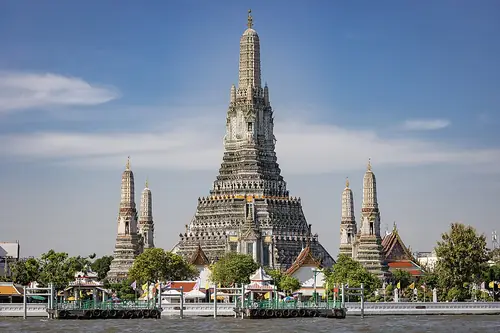
| Wat Arun | Temple of Dawn, porcelain-studded spire on the west bank | 200 baht | Cross by ferry from Tha Tien pier |
| Chatuchak Weekend Market | Thousands of stalls, food included | Free | Saturday and Sunday only; go early |
| Thonburi canals (khlongs) | Stilt houses and waterside temples by longtail boat | Boat hire varies | Agree the price and duration at the pier |
Temple prices are the published foreigner rates as of October 2026 and change occasionally, so carry cash and check at the gate.
What should you eat in Bangkok?
Street food is the main event, and it is cheap. Follow the local queue, not the menu in four languages.
- Pad thai: stir-fried noodles cooked to order. Thip Samai near the Old City is the famous one, but neighbourhood carts are just as good.
- Boat noodles: small, intense bowls you order two or three at a time. Victory Monument has a whole cluster of boat-noodle shops.
- Mango sticky rice: sweet mango with coconut sticky rice, best in mango season, roughly March to June.
- Market grazing: skewers, curries and fresh fruit at Chatuchak or any night market. Eat little and often.
When is the best time to visit Bangkok?
The cool, dry months win, but every season has a case.
| Season | Weather | Crowds and prices | Best for |
|---|---|---|---|
| Cool and dry (Nov to Feb) | Warm days, lower humidity, little rain | Busiest, peak hotel rates | Sightseeing in comfort |
| Hot (Mar to May) | The hottest, most humid months | Easing | Songkran and lower prices, if you tolerate heat |
| Rainy (Jun to Oct) | Short, heavy afternoon downpours | Quietest, cheapest | Bargain hotels; pack a rain shell |
Songkran, the Thai New Year on 13 to 15 April, turns the streets into a citywide water fight. It is great fun, and everything you carry gets soaked. For month-by-month detail across the country, see our best time to visit Thailand guide.
Where should you stay in Bangkok?
Choose a short walk to a BTS or MRT station first, then match the area to your plans:
- Siam or Pratunam: central, shopping malls, two BTS lines meet at Siam.
- Sukhumvit (Asok, Phrom Phong): the widest hotel choice and a BTS/MRT interchange at Asok.
- Riverside or Old City: closest to the temples and the boats, quieter at night.
Our where to stay in Bangkok guide compares the areas in detail, and our Bangkok budget hotel picks shortlist properties once you have chosen one.
Frequently Asked Questions
What is the best time to visit Bangkok?
November to February is the best time to visit Bangkok: the cool, dry season with warm days, low humidity and little rain. March to May is the hottest stretch of the year, and June to October is the rainy season, which usually means short, heavy afternoon showers rather than all-day rain and the lowest hotel prices.
Do I need a visa for Bangkok?
Many nationalities, including US, UK, Canadian and Australian passport holders, can stay in Thailand visa-free for up to 30 days for tourism since 15 September 2026 (it was 60 days before). Every foreign visitor must also complete the free Thailand Digital Arrival Card online within 72 hours before arrival. Confirm the rule for your passport before you fly.
Where should I stay in Bangkok for the first time?
For a first visit, choose a base close to the BTS or MRT: Siam or Pratunam is central, while Asok or Phrom Phong on Sukhumvit offers easy rail connections; the Riverside or Old City suits a more sightseeing-focused trip. Compare the trade-offs in our dedicated Bangkok neighbourhood guide before booking.
How do I get from Suvarnabhumi airport into central Bangkok?
The Airport Rail Link runs from Suvarnabhumi Airport to Phaya Thai, where it connects to the BTS Skytrain, for 45 baht in around 26 to 30 minutes, roughly 05:30 to midnight. It is far cheaper than a taxi and never stuck in traffic. If you take a taxi, insist on the meter and expect expressway tolls on top.
What food should I try in Bangkok?
Eat on the street. Pad thai from a wok cart, boat noodles in small bowls, grilled skewers and mango sticky rice for dessert are the classics, usually for a few dozen baht. Chatuchak weekend market and the city’s food streets are where to graze. Follow the local queue, not the laminated tourist menu.
How many days do you need in Bangkok?
Three to four days is enough to see the headline sights without rushing: a morning at the Grand Palace and Wat Pho, Wat Arun across the river, a weekend morning at Chatuchak market, a canal trip, and time to eat your way through a few neighbourhoods. Add a day or two for day trips or a slower pace in the heat.
Ready to plan your Bangkok trip?
Don’t book a hotel until you have checked how far it is from the nearest BTS or MRT station: a cheap room a 15-minute walk from the Skytrain costs you more in taxis and heat than it saves. Pick your dates in the cool season if you can, then compare.
Find cheap flights to Bangkok | Compare Bangkok hotel prices
Planning the wider trip? See our Thailand itinerary, the Thailand budget guide, Chiang Mai and Phuket, or browse more stays on the hotels hub.