Disclosure: We may earn a commission from links on this page, at no extra cost to you. How we earn
This article contains affiliate links. If you make a booking through these links, we may earn a commission at no extra cost to you. About & Affiliate Disclosure
Quick Answer
- Warm and cheap: Tunisia is an overlooked, welcoming Mediterranean country: mint tea, real hospitality, prices a fraction of southern Europe.
- Get around by louage: shared intercity vans that leave when full are the cheapest, fastest way between towns; collective taxis cover short hops.
- Grab a cheap local SIM: Ooredoo / Orange / Tunisie Telecom tourist SIMs are a few dinars with plenty of data (passport to register), or an eSIM before you fly.
- Where to go when: summer = Cap Bon gems (Kelibia, El Haouaria) and Bizerte, not Sousse/Hammamet; winter = Tabarka and Aïn Draham; the south for the Sahara and the Star Wars sites.
- Customs warning: drones are banned for tourists and confiscated at the airport, and skip camera / “smart” glasses too.
Tunisia: The Mediterranean Escape Hiding in Plain Sight
Most travellers budgeting for a Mediterranean trip default to Italy or Greece, queuing for the same beaches at the same prices. A visitor who lands in Tunisia instead is often handed a glass of sweet mint tea within the hour by someone who refuses payment for it. That’s the thing this Tunisia travel guide keeps coming back to: it’s an overlooked, wallet-friendly Mediterranean country barely an hour or two from Europe, with some of the warmest people you’ll meet anywhere.
Here’s the fast answer. Tunisia gives you the whole spread: clear-water beaches, Roman ruins bigger than the ones tourists queue for in Europe, blue-and-white clifftop villages, and the actual Sahara: at a fraction of the cost and a fraction of the crowds. The catch isn’t the place; it’s that most visitors only ever see the package-resort strip and assume that’s all there is.
You probably don’t need a tour group or a fat budget for this. You need to know how to move around (it’s cheaper and easier than you’d think), where the real finds are versus the tourist coast, and one customs rule that catches people out before they’ve even left the airport. The first thing to sort is how to actually get between towns, because that single trick shapes the whole trip.
What to pack for Tunisia
Four picks from our gear guides that suit this trip. Each card opens the live Amazon price; the links below lead to the full comparisons.
25 x 18 x 4 cm, 254 g, 2.1 L. Locking zips, a cut-resistant double-cable strap, an RFID passport pocket and a strap that clips to a chair. Reader’s Digest’s best crossbody for travel.
Check price on Amazon Live price on AmazonThe best value compression set going. A double-zip pulls the air out so a week of clothes shrinks to a few inches thick, and you get eight pieces (cubes plus a shoe and laundry bag) for roughly the price of one branded cube. The fabric is thin and the zips aren’t lifetime kit, but for the money nothing beats it.
Check price on Amazon Live price on AmazonThe reliable all-rounder: one USB-C and four USB-A ports, plugs for 200+ countries, and a built-in fuse with a spare. The adapter most people should buy.
Check price on Amazon Live price on AmazonModel A1259, 10,000mAh, about 37Wh, 215 g. Two phone charges in a jacket pocket, and small enough that the two-bank limit never becomes a question.
Check price on Amazon Live price on AmazonGetting around Tunisia (and the SIM trick)
This is the practical engine of a Tunisia trip, and it’s where the savings live. Forget car-hire stress and rigid bus timetables: locals get around on a system that’s cheap, constant and weirdly efficient once you understand it.
The backbone is the louage, a shared intercity van, white with a coloured stripe down the side, that runs between towns. There’s no timetable: it simply leaves the louage station the moment it fills up, which in practice is rarely a long wait. It’s the cheapest and usually the fastest way to get from one town to the next, and it’s how most Tunisians travel.
For shorter hops there are collective taxis (taxi jama3i): shared taxis that run fixed routes and pick up passengers along the way, splitting the fare. Then come the buses: SNTRI handles long-distance intercity routes, regional SRT lines fill in the gaps, and in the capital the TGM line links central Tunis to Carthage and Sidi Bou Saïd along the coast, backed up by the city metro (a tram, really).
The last piece is staying connected. A local tourist SIM from Ooredoo, Orange Tunisie or Tunisie Telecom costs just a few dinars and comes loaded with generous data. Bring your passport to register at any operator shop. Prefer to skip the queue entirely? Set up a travel eSIM before you fly, so you’ve got maps and translation working the second you step off the plane.
- Activate before you fly: data works on arrival
- Plans for 200+ countries from a few dollars
- Keep your number; no physical SIM swap
Once you’ve got a SIM and you know how to flag a louage, the whole country opens up, and the best of it is nowhere near the resorts.
Tunisia’s hidden gems (beyond touristy Sousse & Hammamet)
Let’s be honest about the coast first. Sousse and Hammamet are the package-tourist Tunisia: big resort strips that are perfectly pleasant and completely beside the point. The real finds, the ones that make people quietly obsessed with this country, are elsewhere.
Cap Bon peninsula (a summer dream)
The Cap Bon peninsula, jutting north-east toward Sicily, is where Tunisians themselves go to swim. Kelibia is the anchor: a fishing town crowned by a honey-coloured hilltop Borj (fort) with views over the whole coast, and just down the road the clear, shallow water of El Mansourah beach. Further up, El Haouaria sits at the cape’s tip with its ancient sea caves, dramatic cliffs, a kitesurfing scene, and a famous spring bird migration that draws watchers from across Europe. And tucked nearby is Kerkouane: the only Punic (Carthaginian) town left intact anywhere, a quiet UNESCO site that almost no tour buses reach. You can wander its 2,500-year-old streets practically alone.
Bizerte, the northern old port
Bizerte, up on the north coast, is the kind of place that doesn’t try to impress you and wins you over anyway. Its picturesque old harbour (vieux port) is ringed with fishing boats and pastel houses, the Andalusian medina behind it is all narrow lanes and the rhythm of daily life, and there are quiet beaches strung along the coast nearby that you’ll often have largely to yourself.
Sidi Bou Saïd & Gammarth: “the Santorini of Tunisia”
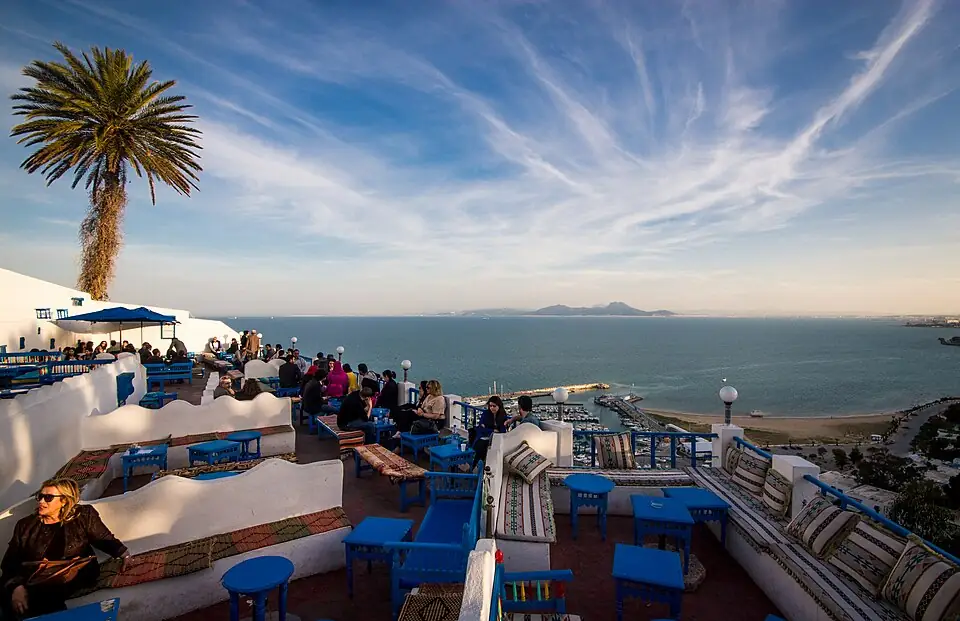
Perched on a cliff above the sea just outside Tunis, Sidi Bou Saïd is the blue-and-white village people mean when they call somewhere the Santorini of Tunisia. Cobbled lanes, whitewashed walls, blue doors and shutters, jasmine spilling over everything, and a café culture built for slow afternoons watching the water with a mint tea. Next door, the Gammarth coast stretches out with a calmer, beachy feel.
El Jem: “the Colosseum of Africa”
Inland sits one of the best-preserved Roman amphitheatres on Earth. El Jem is bigger and far emptier than Rome’s Colosseum, and here you can actually walk the arena floor and the underground tunnels where gladiators and animals once waited. It’s the kind of sight that would be mobbed and ticketed within an inch of its life in Europe, and you’ll often have the upper tiers to yourself.
The deep south: Sahara & Star Wars
This is where Tunisia turns cinematic, literally. Tataouine is the gateway to the ksour (fortified Berber granaries like the multi-storey Ksar Ouled Soltane), and the troglodyte (underground) houses of Matmata, dug into the earth to beat the heat. Star Wars fans will know the names: the planet “Tatooine” took its name from Tataouine, and filming locations like Ksar Hadada and the dunes near Nefta stand in for that galaxy far, far away. From here you’re on the doorstep of the Sahara, with camel treks and 4x4 trips out to the dunes.
The green north-west (a winter surprise)
Most people don’t picture Tunisia as green and forested, but the north-west is exactly that. Tabarka on the Coral Coast has a Genoese fort on its rocky islet and the dramatic “Aiguilles”: needle-shaped rock formations rising from the sea. Inland, Aïn Draham is a cork-oak mountain town that’s genuinely cool and green, sometimes even dusted with snow in winter, a completely different, woodland side of the country.
Best time to visit Tunisia
Tunisia runs warm year-round, but the season you pick decides which Tunisia you get, and getting it wrong (the desert in July, the mountains with no warm layers) is the easiest mistake here. Spring (March–May) is the all-round sweet spot. The rest depends on what you’re chasing.
| Season | Weather | Crowds | Prices | Best for |
|---|---|---|---|---|
| Spring (Mar–May) | Warm, green, 18–27°C | Light | Low–mid | The all-round sweet spot, everywhere is pleasant |
| Summer (Jun–Sep) | Hot coast, brutal desert, 28–38°C | Coast busy | Mid (resorts peak) | Cap Bon beaches (Kelibia, El Haouaria) and Bizerte, skip the Sahara |
| Autumn (Oct–Nov) | Warm, settling, 20–30°C | Easing | Good value | The south and the Sahara, ideal desert weather |
| Winter (Dec–Feb) | Mild coast, cold desert nights, 8–18°C | Lowest | Cheapest | The green north-west mountains (Tabarka, Aïn Draham) |
A couple of judgement calls the table can’t make for you: don’t romanticise the Sahara in summer: daytime heat in the deep south is genuinely punishing, and it’s the one time to stay on the coast instead. And in winter the desert flips the other way: pleasant by day, properly cold at night, so pack layers if you’re heading to a desert camp. If you only get one trip and want the safest bet across beaches, ruins and towns alike, go in spring.
Where to stay in Tunisia
There’s no single base for Tunisia: the country is long and varied, and the smart move is to match your base to your season and your shortlist. Here’s how the main options compare.
| Base | Vibe | Best for |
|---|---|---|
| Tunis / Sidi Bou Saïd | Capital culture, blue-and-white clifftop charm | Culture, medina markets, an easy first base near the airport |
| Cap Bon / Kelibia | Fishing-town beaches, clear water | Summer swimming away from the resort strip |
| Bizerte | Quiet northern old port | A slower, local coast with beaches nearby |
| Tabarka / Aïn Draham | Coral Coast + cork-oak mountains | Winter escapes, forest and cooler air |
| The south (Tataouine / Douz) | Desert gateway, ksour and dunes | The Sahara, camel trips and the Star Wars sites |
For a first trip, Tunis or right next door in Sidi Bou Saïd is the base worth choosing. Both put the capital’s medina markets, the clifftop village and the airport on the doorstep, all linked by the TGM line. From there, pick the season’s region and ride a louage out to it. Compare live rates anytime on our hotels hub.
Frequently Asked Questions
What is the best time to visit Tunisia?
Spring (March to May) is the all-round sweet spot, warm, green and uncrowded. Summer (June to September) is for the Cap Bon beaches and Bizerte, but skip the desert, it’s brutal. Autumn (October to November) is ideal for the south and the Sahara, and winter (December to February) is mild on the coast and the time for the green north-west mountains.
How do I get around Tunisia?
The cheapest, fastest way between towns is a louage, a shared intercity van (white with a coloured stripe) that leaves the louage station when it’s full, no timetable. For short hops there are collective taxis (taxi jama3i) on fixed routes. SNTRI runs long-distance buses, regional SRT lines cover the rest, and Tunis has the TGM line and a metro.
Is a local SIM in Tunisia cheap, and how do I get data?
Yes. Ooredoo, Orange Tunisie and Tunisie Telecom sell tourist SIMs with generous data for just a few dinars. Bring your passport to register at any operator shop. If you’d rather not queue, set up a travel eSIM before you fly so data works the moment you land.
Can I bring a drone to Tunisia?
No. Drones are effectively banned for tourists and are routinely confiscated at the airport customs (douane), so leave yours at home. Camera or “smart” glasses can also trigger problems at customs, so it’s safest not to pack them either.
Is Tunisia safe and welcoming for travellers?
Tunisia is one of the warmest, most hospitable places in the Mediterranean. Expect mint tea, easy conversation and genuine generosity. Use normal city sense, carry small cash, and you’ll find it relaxed and friendly, especially in the smaller coastal and mountain towns away from the package resorts.
Is Tunisia cheap to travel?
Very. Tunisia is one of the best-value Mediterranean countries: meals, transport (louages), local SIMs and stays all cost a fraction of southern Europe. It’s a cash country outside hotels, so carry dinars, and remember the dinar can’t be taken out, so spend it before you fly home.
Start Planning Your Tunisia Trip
Get the season and the region right and Tunisia delivers more variety (beaches, ruins, villages, desert and forest) than countries three times the price: a cheap flight, mint tea everywhere, empty Roman arenas and a stretch of Cap Bon coast still well below the tourist radar. Skip the resort strip, ride the louages, and follow the seasons.
Compare prices now and lock in your dates. Tunis-Carthage (TUN) is the main gateway, with Djerba (DJE) and Enfidha (NBE) handy for the south and the resort coast:
Find cheap flights to Tunisia | Compare Tunisia hotel prices
Planning the wider trip? Browse more guides on our destinations hub and find a place to stay on the hotels hub.