Quick Answer
- Best months: November to June, highs about 25 to 28°C, almost no rain.
- Winter: 25.0 to 26.1°C from December to January, with steady trade winds.
- Stay: Santa Maria for walking and cafés, an all-inclusive for everything on site.
- Airport: taxi to Santa Maria, about 20 minutes and around 15 to 20 euros.
- Before you fly: EASE pre-registration and the 30.83-euro TSA.
At a glance
- Best time
- Nov–Jun, dry and 25–28°C
- Time needed
- 5 to 7 days
- Currency
- Cape Verdean escudo, 110.265 per euro
- Language
- Portuguese and Cape Verdean Creole
- From the airport
- Taxi to Santa Maria, around 20 minutes
- Getting around
- Taxis and aluguer minibuses
Sal is the flat, dry, sandy island that most winter-sun flights to Cape Verde land on. Turismo Cabo Verde says it accounts for more than half of the country’s tourist overnight stays, and it is named after the salt that was its industry from the eighteenth to the mid-twentieth century. Prices and dates below were checked on 10 October 2026; our Cape Verde country guide compares the other islands.
When is the best time to visit Sal?
| Month | Average high / low | Rain | Rainy days | What it is like |
|---|---|---|---|---|
| January | 25.0°C / 19.2°C | 2.8 mm | 0.5 | Winter sun, steady wind |
| February | 24.9°C / 18.8°C | 0.5 mm | 0.2 | Coolest month, still beach weather |
| March | 25.2°C / 18.9°C | 0.5 mm | 0.1 | Dry and breezy |
| April | 25.5°C / 19.6°C | 1.0 mm | 0.2 | Dry, Easter crowds |
| May | 26.1°C / 20.6°C | 0.5 mm | 0.1 | Calmer, quieter |
| June | 27.0°C / 21.6°C | 0.0 mm | 0.0 | Warm and dry |
| July | 28.1°C / 22.8°C | 2.4 mm | 0.1 | Summer holidays |
| August | 29.6°C / 24.2°C | 12.8 mm | 1.2 | Hot, humid, first rains |
| September | 30.1°C / 24.8°C | 34.5 mm | 2.7 | Wettest and hottest month |
| October | 29.6°C / 24.1°C | 15.6 mm | 1.1 | Hot, rains fading |
| November | 28.1°C / 22.5°C | 1.3 mm | 0.4 | Best start to winter sun |
| December | 26.1°C / 20.5°C | 3.4 mm | 0.5 | Christmas sun, busiest weeks |
Figures are the WMO Climate Normals for 1991-2020 for the Sal station, run by Cabo Verde’s Instituto Nacional de Meteorologia e Geofísica and published in NOAA’s NCEI archive. The whole year brings only 75.3 mm of rain. Winter is the windy season, which is great for kitesurfing and less great for a sunbed on the east coast. Our winter sun in Europe guide compares Sal with the Canary Islands, and where to go in November explains why Sal tops our short-haul list that month.
Where should you stay on Sal: Santa Maria or an all-inclusive?
Almost everyone stays at the southern end of the island, around Santa Maria. The real choice is between a room in town and a resort outside it.
| Area | Best for | Trade-off |
|---|---|---|
| Santa Maria town | Walking to the beach, the pier, cafés and restaurants; independent travellers | Smaller hotels and apartments, some street noise |
| Resort strip west and east of town | All-inclusive families, pools, everything on site | Isolated; you eat where you sleep and taxi into town |
| Espargos | Cheap rooms near the airport, local life | No beach; 20 minutes from Santa Maria |
| Murdeira and the west coast | Quiet villas and apartments | Few services; you need taxis |
Be honest with yourself about what you want. All-inclusive is easier with children and on a fixed budget, but the large resorts can feel cut off from the island, and town stays let you try local food such as cachupa, the slow-cooked corn and bean stew. In a Booking.com check on 10 October 2026, apartments in Santa Maria started at around 95 to 105 euros a night for two for a mid-January week, while a beachfront five-star resort ran to around 285 euros a night. Compare live rates here: compare Santa Maria hotel prices .
How do you get to and around Sal?
Flights. Amílcar Cabral International Airport, next to Espargos in the middle of the island, is one of Cape Verde’s four international airports and has connections to the main European markets, according to Turismo Cabo Verde. From London the flight takes around six hours.
From the airport. A taxi to Santa Maria takes about 20 minutes and costs around 15 to 20 euros; agree the price before you set off, as fares are not metered, and expect a little more after midnight. Many package holidays include a transfer.
Getting around. Aluguers, the shared minibuses, run between Santa Maria and Espargos and on to Palmeira; they leave when full and are paid in cash. Taxis cover the rest. The island is flat and small, so a single day tour with a driver covers all the main sights.
Other islands. CV Interilhas ferries call at Palmeira on Sal; on 10 October 2026 its departures board showed Boa Vista to Sal at around 3 hours, overnight. Domestic flights are faster but schedules are thin, so book them before you arrive.
What should you not miss on Sal?
- Santa Maria beach and pier. A long sweep of white sand along the south coast, the most sheltered on the island from the north-east wind. The wooden pier in the middle is where fishermen land and clean their catch.
- Pedra de Lume salt crater. Salt has been worked inside an old volcanic crater on the east coast since the island’s salt-trade era. You float in brine far saltier than the sea; an entrance fee is charged at the tunnel into the crater, so carry cash.
- Shark Bay (Baía da Parda). On the west coast, young lemon sharks swim in shallow water close to the shore. Wear water shoes on the rocks, keep your distance and never touch or feed them.
- Buracona. A natural rock pool on the north-west coast with a cave known as the Blue Eye, which lights up when the sun is high, so go around midday. Swim only when the sea is calm.
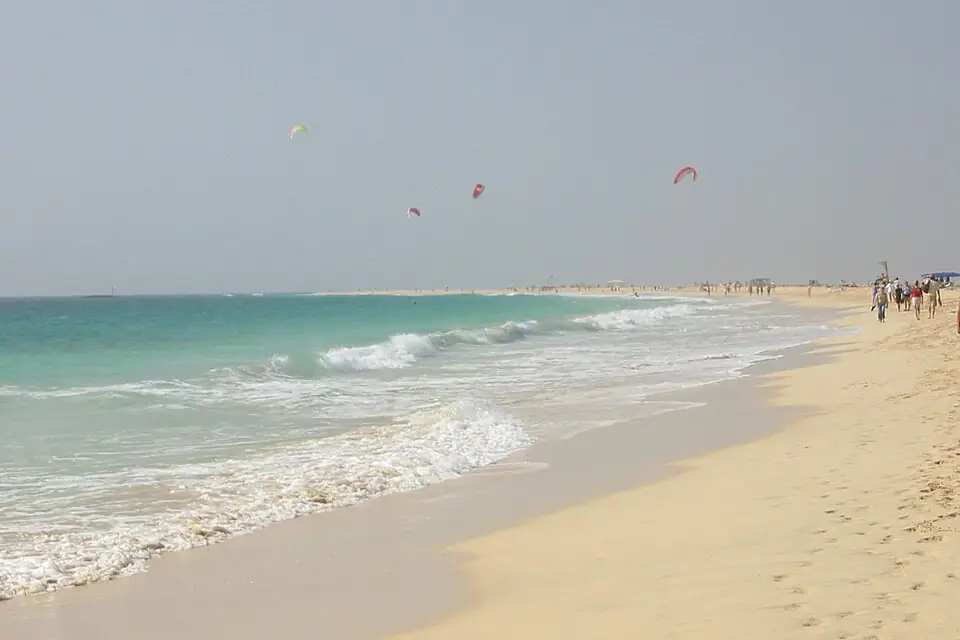
- Kitesurfing at Kite Beach and Ponta Preta. Sal’s east coast and the wave break at Ponta Preta are its best-known wind spots; book lessons with a certified school.
- Murdeira Bay and Palmeira. Turismo Cabo Verde lists Murdeira, Ponta Preta and Buracona among the island’s must-visit places; Palmeira is the small working port on the west coast.
What can you do beyond Sal?
Sal itself is small. For a second island, Boa Vista has longer, emptier beaches; São Vicente has Mindelo’s music and food scene and the hour-long CV Interilhas ferry to Santo Antão’s hiking valleys; and Fogo has the 2,829-metre Pico do Fogo volcano. The Cape Verde guide compares them.
What goes wrong on Sal?
- Forgetting EASE. Skipping the pre-registration means queues on arrival and, from 1 July 2026, double the airport security tax.
- Picking a resort for the beach and finding the wind. Exposed beaches can be blowy in winter; Santa Maria’s south-facing bay is the most sheltered.
- Swimming in rough sea. Atlantic swell can be strong on the north and west coasts; at Buracona and Shark Bay, follow the guides and the flags.
- Unagreed taxi fares. Settle the price before the ride, in euros or escudos.
How many days do you need on Sal?
Five to seven days suits a beach holiday on Sal, with one day for an island tour of Pedra de Lume, Buracona and Shark Bay. With ten days or more, add a second island.
- Activate before you fly: data works on arrival
- Plans for 200+ countries from a few dollars
- Keep your number; no physical SIM swap
Frequently Asked Questions
What is the best time to visit Sal?
November to June is the best time for most trips. The 1991-2020 WMO climate normals for the Sal station give average highs of 25.0 to 28.1°C in those months, with well under one rainy day a month. August to October is the short rainy season, with September the wettest month at 34.5 mm. Winter is the windiest stretch, which suits kitesurfers but makes exposed beaches feel cooler.
Is Sal warm in December and January?
Yes. Sal averages a daily high of 26.1°C in December and 25.0°C in January, with lows around 19 to 20°C, according to the 1991-2020 WMO normals for the Instituto Nacional de Meteorologia e Geofísica station. Both months average just 0.5 rainy days. The north-east trade winds are steady in winter, so bring a light layer for evenings and pick a sheltered beach.
Where should I stay on Sal?
Stay in or near Santa Maria, the town at the southern tip, where the beach, the pier, cafés and most hotels are. Small hotels and apartments in town let you walk everywhere and eat out. The big all-inclusive resorts line the coast west and east of town: they are simpler for families but more isolated. Espargos, the island’s main town near the airport, has no beach.
How do I get from Sal airport to Santa Maria?
Amílcar Cabral International Airport is about a 20-minute drive from Santa Maria. A taxi costs around 15 to 20 euros: agree the fare before you get in, and expect slightly more late at night. Many package holidays include a hotel transfer. Aluguer minibuses run between Espargos and Santa Maria for much less, but they leave when full and are not practical with heavy luggage.
How much is the Cape Verde airport security tax?
Turismo Cabo Verde puts the airport security tax (TSA) at 30.83 euros. You pay it together with the EASE pre-registration at ease.gov.cv, which the UK government says to complete at least 5 days before arrival. Children aged one and under are exempt, and from 1 July 2026 visitors who have not pre-registered pay double the TSA at the border.
How many days do you need on Sal?
Five to seven days suits a beach holiday on Sal: one day for an island tour covering Pedra de Lume, Buracona and Shark Bay, and the rest for the beach and water sports. Sal is small and flat, so there is little extra to see beyond that. With ten days or more, add a second island such as Boa Vista, São Vicente or Santo Antão.
Start planning your Sal trip
Christmas, New Year and February half-term are the busiest weeks, so book early for those; November, early December and late January are cheaper and just as dry.
Find cheap flights to Sal | Compare Santa Maria hotel prices
More ideas: where to go in December, where to go in January and our Hurghada guide for Red Sea winter sun.