Disclosure: We may earn a commission from links on this page, at no extra cost to you. How we earn
This article contains affiliate links. If you make a booking through these links, we may earn a commission at no extra cost to you. About & Affiliate Disclosure
Quick Answer
- Best overall: November to June, highs about 25 to 28°C and almost no rain on Sal.
- Winter: 24.9 to 26.1°C from December to February, with steady trade winds.
- Before you fly: EASE pre-registration and the 30.83-euro TSA, at least 5 days ahead.
- First trip: Sal or Boa Vista for beaches, Santo Antão or Fogo for hiking.
- Money: escudos, fixed at 110.265 per euro.
At a glance
- Best time
- Nov–Jun, dry and 25–28°C
- Time needed
- 7 to 10 days
- Currency
- Cape Verdean escudo, 110.265 per euro
- Language
- Portuguese and Cape Verdean Creole
- Getting around
- Domestic flights, CV Interilhas ferries
Cape Verde (Cabo Verde) is ten volcanic islands in the Atlantic, about 320 nautical miles (roughly 590 km) off the coast of Senegal, according to Turismo Cabo Verde. Sal, Boa Vista and Maio are flat, sandy and dry; Santiago, Santo Antão, São Vicente and Fogo are mountainous and greener. Four of the islands have international airports (Sal, Boa Vista, Santiago and São Vicente), and most winter-sun charters from Europe land on Sal or Boa Vista. All figures below were checked on 10 October 2026.
Cape Verde month by month
The table uses the WMO Climate Normals for 1991-2020 for the Sal station, run by Cabo Verde’s Instituto Nacional de Meteorologia e Geofísica (INMG) and published in NOAA’s NCEI archive.
| Month | Average high / low (Sal) | Rain | Rainy days | Best for |
|---|---|---|---|---|
| January | 25.0°C / 19.2°C | 2.8 mm | 0.5 | Winter sun, kitesurfing |
| February | 24.9°C / 18.8°C | 0.5 mm | 0.2 | Coolest month, Mindelo Carnival season |
| March | 25.2°C / 18.9°C | 0.5 mm | 0.1 | Dry and breezy, Easter breaks |
| April | 25.5°C / 19.6°C | 1.0 mm | 0.2 | Hiking on Santo Antão and Fogo |
| May | 26.1°C / 20.6°C | 0.5 mm | 0.1 | Calmer winds, fewer crowds |
| June | 27.0°C / 21.6°C | 0.0 mm | 0.0 | Warm sea, start of turtle season |
| July | 28.1°C / 22.8°C | 2.4 mm | 0.1 | Summer holidays, turtle nesting |
| August | 29.6°C / 24.2°C | 12.8 mm | 1.2 | Hot and humid, first rains |
| September | 30.1°C / 24.8°C | 34.5 mm | 2.7 | Wettest month, hottest sea |
| October | 29.6°C / 24.1°C | 15.6 mm | 1.1 | Rains fading, still hot |
| November | 28.1°C / 22.5°C | 1.3 mm | 0.4 | Winter sun begins |
| December | 26.1°C / 20.5°C | 3.4 mm | 0.5 | Christmas sun, busiest weeks |
The mountainous islands catch more of the August to October rain: Praia on Santiago averages 75.3 mm in September across 5 rainy days, against 34.5 mm on Sal. Sal’s whole year adds up to just 75.3 mm. Dust from the Sahara (the harmattan haze) can dull the sky for a few days at a time in winter, but it rarely stops a beach day.
Top Cities to Explore
Best time to visit Cape Verde by trip type
Winter sun (November to April)
This is the main season. From November to April, Sal averages 24.9 to 28.1°C by day and almost never rains, which puts it a few degrees above the Canary Islands in mid-winter; our winter sun in Europe guide compares the Canaries in detail. Cape Verde features as the most reliable short-haul pick in our where to go in November and where to go in December guides. Christmas and New Year weeks are the most expensive, and the first half of December and January after the school holidays are the value windows.
For a first trip, stay in Santa Maria on Sal: our Sal island guide compares the town with the all-inclusive strip.
Kitesurfing and windsurfing (roughly November to May)
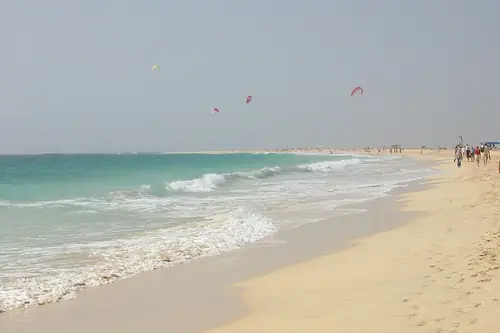
The north-east trade winds are the reason Sal and Boa Vista are known for wind sports. They are strongest and steadiest in winter and spring, so this is the main kitesurfing season, with Kite Beach and the wave spot at Ponta Preta on Sal the best known. If you only want to lie on a sheltered beach, Santa Maria’s south-facing bay is the stretch of Sal best sheltered from the north-east wind.
Hiking and volcanoes (November to June)
The dry months are also the hiking season. Santo Antão has the archipelago’s steepest green valleys, around Paúl and Ribeira Grande, and Fogo’s Pico do Fogo rises to 2,829 metres, the highest point in Cape Verde according to Turismo Cabo Verde. Hike with a local guide on Fogo, where the trails cross loose volcanic ash.
Turtles and summer (June to October)
Turismo Cabo Verde lists June to September as the season when loggerhead turtles (Caretta caretta) nest on Boa Vista’s beaches, and guided night watches run in that window. Summer is hotter and more humid, and September is the wettest month.
Which Cape Verde island should you choose?
| Island | Best for | Trade-off |
|---|---|---|
| Sal | First beach trip, kitesurfing, most flights | Flat and dry, little greenery |
| Boa Vista | Long empty beaches, dunes, big resorts | Resorts are isolated; little town life outside Sal Rei |
| Santiago (Praia) | Culture, the capital, Cidade Velha (UNESCO) | City beaches are not the draw |
| São Vicente (Mindelo) | Music, food, Carnival, the ferry to Santo Antão | Windy beaches, fewer direct flights |
| Santo Antão | Hiking the green valleys | No airport: reached by ferry from Mindelo |
| Fogo | Climbing an active volcano | Long ferry or domestic flight, basic lodging |
Most visitors combine one beach island with one hiking or culture island: Sal or Boa Vista with São Vicente and Santo Antão is the classic pairing.
How much does Cape Verde cost per day?
The fixed costs below come from official sources. Hotels swing with the season: in a Booking.com check on 10 October 2026, apartments in Santa Maria on Sal started at around 95 to 105 euros a night for two for a mid-January week, while a beachfront five-star resort ran to around 285 euros a night.
| Item | Cost |
|---|---|
| Airport security tax (TSA), paid with EASE | 30.83 euros (3,400 escudos) |
| Exchange rate (fixed) | 110.265 escudos per euro |
| Taxi, Sal airport to Santa Maria | Around 15 to 20 euros (agree before you go) |
| Ferry, São Vicente to Santo Antão | Around 1 hour; book with CV Interilhas |
How to get around Cape Verde
Domestic flights. Inter-island flying has changed several times: Cabo Verde Airlines (TACV) restarted domestic routes in 2024, and CVsky, a new state-owned airline flying ATR 72-600 turboprops, began selling inter-island tickets in February 2026 for the 2026 summer schedule. Schedules are thin, so book the connection before you fly in and leave a buffer before your flight home.
Ferries. CV Interilhas runs the public ferry network. Its live departures board on 10 October 2026 showed the São Vicente to Santo Antão crossing at around 1 hour, Fogo to Brava at around 1 hour, Fogo to Santiago at around 4 hours, Santiago to Boa Vista at around 7 hours and Boa Vista to Sal at around 3 hours, with some sailings overnight. The Atlantic is rough in the windy season, so plan around delays.
On the islands. Shared minibuses called aluguers link the towns on each island and are the cheapest way to get around; taxis wait at airports and ports. On Sal and Boa Vista, many visitors use hotel transfers.
Entry requirements, money and connectivity
Entry. Non-resident visitors must complete the EASE pre-registration at ease.gov.cv and pay the airport security tax (TSA). Turismo Cabo Verde puts the TSA at 30.83 euros, the 3,400-escudo figure the Spanish embassy in Praia published when the system started in 2019. The UK government advises doing it at least 5 days before arrival, exempts children aged one and under, and warns that from 1 July 2026 anyone who has not pre-registered pays double the TSA at border control. EU and UK citizens can stay up to 30 days without a visa. From 1 January 2026, nationals of the countries on the government’s published list need a visa from a Cabo Verde embassy before they travel, including for transit. Your passport should be valid for at least 6 months after arrival.
Money. The Cape Verdean escudo (CVE) is pegged to the euro at 110.265 per euro. ATMs and card terminals work on the Visa network, according to Turismo Cabo Verde; decline dynamic currency conversion and pay in escudos.
Language. Portuguese is the official language and Cape Verdean Creole (Kriolu) is spoken everywhere; English is common in the hotels of Sal and Boa Vista.
Mobile data. Cape Verde is not covered by EU roaming, so check your plan before you go or compare global options in our best eSIM for travel guide. For sockets, see travel adapters by country.
- Activate before you fly: data works on arrival
- Plans for 200+ countries from a few dollars
- Keep your number; no physical SIM swap
Frequently Asked Questions
What is the best time to visit Cape Verde?
November to June is the best time for most trips. The 1991-2020 WMO climate normals for Sal give average highs of 25.0 to 28.1°C from November to June and well under one rainy day a month. August to October is the short rainy season: September averages 34.5 mm and 2.7 rainy days on Sal, and more on the mountainous islands. Winter is also the breeziest stretch, which suits kitesurfers more than sunbathers on exposed beaches.
Is Cape Verde warm in winter?
Yes. Sal averages a daily high of 26.1°C in December, 25.0°C in January and 24.9°C in February, with nights around 19 to 20°C, according to the 1991-2020 WMO normals for the Instituto Nacional de Meteorologia e Geofísica station. Rain is close to nil, at 0.5 rainy days in December and January. The trade winds make it feel cooler than the numbers on an exposed beach, so pack a light layer for the evenings.
Do I need to pre-register before travelling to Cape Verde?
Yes. Visitors who are not residents must complete the EASE pre-registration at ease.gov.cv and pay the airport security tax (TSA), which Turismo Cabo Verde puts at 30.83 euros. The UK government says to do this at least 5 days before arrival, that children aged one and under are exempt, and that from 1 July 2026 travellers who have not pre-registered pay double the TSA at the border.
Do I need a visa for Cape Verde?
Most European travellers, including EU and UK citizens, can visit for up to 30 days without a visa after completing EASE pre-registration. Since 1 January 2026, citizens of the countries on the government’s published list must obtain a visa from a Cabo Verde embassy before they fly, including for transit. Check the list on ease.gov.cv, and make sure your passport is valid for at least 6 months after arrival.
Which Cape Verde island is best?
Sal is the easiest for a first beach holiday, with the most flights and the walkable town of Santa Maria. Boa Vista has longer, emptier beaches and big resorts. Santiago, with the capital Praia and the UNESCO-listed Cidade Velha, suits culture. São Vicente and its port city Mindelo suit music and food, and Santo Antão, an hour away by ferry, is the hiking island. Fogo is for climbing its 2,829-metre volcano.
What currency does Cape Verde use?
The Cape Verdean escudo (CVE), which is pegged to the euro at 110.265 escudos per euro, according to Turismo Cabo Verde. Euros are widely accepted in tourist areas on Sal and Boa Vista, but change usually comes back in escudos, and cash in escudos is easier for taxis, aluguer minibuses and small shops. ATMs and card terminals work on the Visa network.
Start planning your Cape Verde trip
Christmas, New Year and February half-term fill first, so book flights and rooms early for those weeks; November, early December and late January are cheaper and just as dry.
Find cheap flights to Sal | Compare Santa Maria hotel prices
More ideas: where to go in January, where to go in February and our Egypt guide for Red Sea winter sun.